
Original article: Operación «Fraude Eletoral”: la maquinaria de desinformación de la ultraderecha para erosionar la democracia chilena
Repetitive Script: The Pro-Kast Disinformation Machine Sowing Claims of ‘Fraud’
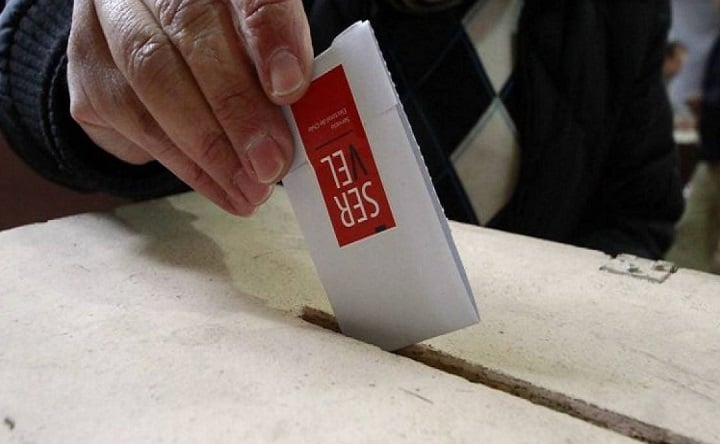
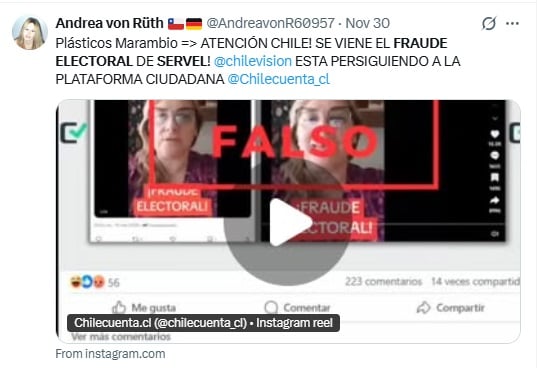
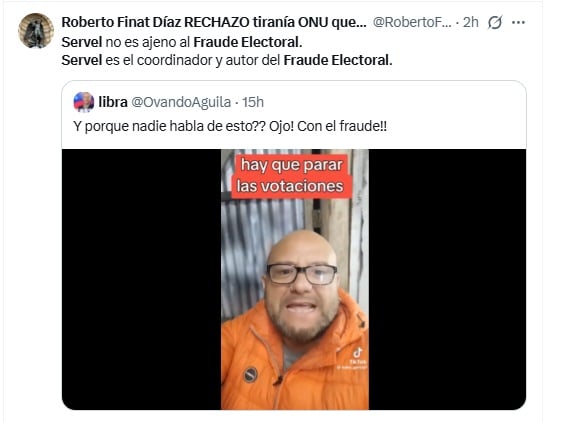
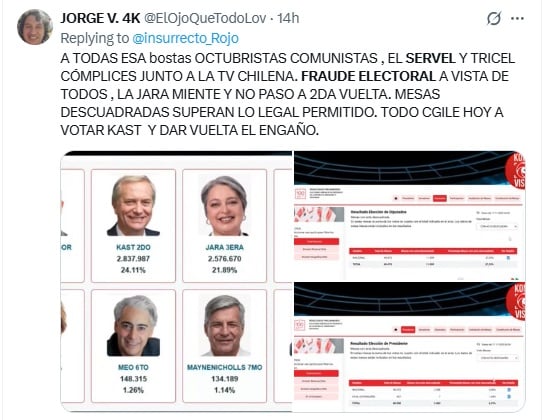
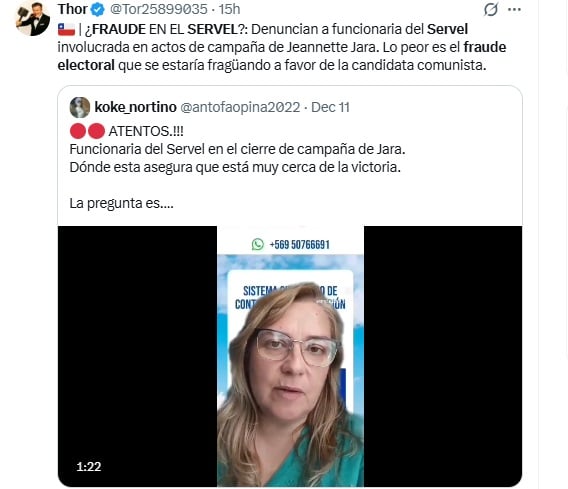
On Sunday, December 14, Chile will determine its presidential future amidst a tainted atmosphere driven by an orchestrated disinformation campaign. The far-right sectors, via a network of troll accounts and bots linked to libertarian and pro-Kast republican groups, have intensified the narrative of alleged «electoral fraud.» The intent is clear: to sow distrust in democratic institutions to politically invalidate a potentially adverse outcome, a tactic with a troubling history in the country and the region.
The accusation of fraud is not spontaneous, but rather a «known, adaptable, and emotionally effective script» in Latin America, as analyzed by political scientist Miguel Torres Romero (Master’s in Social Science Research, UBA), previously published before the first round in El Mostrador.
This script doesn’t require factual evidence; it merely needs to amplify doubts and isolated anecdotes to operate. In Chile, this discursive framework was previously rehearsed, more directly, by José Antonio Kast himself, who after the 2021 elections stated to Radio Agricultura: «We are not accusing massive fraud; we say there could be errors,» calling for a review of the polling stations given a margin of 50,000 votes, according to an interview reported by EMOL, while thousands of troll accounts and bots spread false claims of “electoral fraud.” This rhetoric prepares the ground for the current escalation.
Paradoxically, the right-wing’s allegations of accounts raising doubts coincided with Andrés Tagle as director of SERVEL, a historical electoral expert from the UDI (Kast’s former party), who was president of the agency.
The concrete facts refute the fraud narrative, yet they are used as bait for disinformation. After the first round on November 16, reports about “uneven polling stations” in the SERVEL system went viral. However, a verification by the agency AFP and its ‘Factual’ section, determined these were normal typing errors in the preliminary results, which are transparently corrected during the provisional and final stages by the Scrutiny Colleges and the Tricel. International observers such as Electoral Transparency reported no signs of fraud. Nevertheless, these technical anomalies, inherent to any mass process, are presented as «proof» of a conspiracy.
The strategy has a calculated emotional component to mobilize the electoral base. According to Torres Romero‘s analysis, the fraud allegations evoke outrage, fear, and a collective sense of grievance. It frames the narrative as the defense of a «betrayed popular will,» uniting supporters around the idea of a moral struggle. Social media is the perfect ecosystem for this: a blurry video, a contextually misrepresentative testimony, or a screenshot can go viral within minutes, planting suspicion before a refutation can circulate.
This discourse has a tangible risk of inciting violence. During this ballot day, incidents have been reported, such as that described by journalist Josefa Barraza, of ContraPoder, who, as a polling table president in Puente Alto, recounted how a voter accused falsification because he was “going viral on Tik Tok”.
This situation is not an isolated case, but an expected consequence of a narrative that has led to protests and attacks on institutions in other countries. As Paulina Ibarra, director of Fundación Multitudes, warned in 2022, these campaigns are «gateway to authoritarianism» and echo the strategies of Trump and Bolsonaro, which culminated in the Capitol attack and attempts at destabilization, as highlighted in a publication by Página 19.
The far-right aims to conceal dual objectives with this strategy. First, to transform the electoral scenario into a “theft” orchestrated by the system. Torres Romero explains that this serves as a «damage control» narrative, politically profitable even if it lacks factual sustainability. Secondly, and more structurally, to weaken the credibility of democratic institutions like SERVEL and Tricel.
By eroding trust in the fundamental mechanisms of democracy, they seek to justify a radical and delegitimizing opposition that rejects the rules of the game, further polarizing society.
In facing this narrative offensive, as multiple experts have indicated, it is crucial to remember that Chile has a robust, transparent electoral system audited at multiple levels. However, this technical solidity is not immune to emotional doubts sown by social media. The danger, as experts point out, is that “fraud” is no longer defined in courts but in timelines, where the speed of suspicion outpaces verification. The narrative becomes particularly credible during periods of information silence, such as slow counts or the viralization of isolated incidents.
The scenario the far-right intends to establish is one of perpetual conflict and ungovernability, where the electoral outcome, if unfavorable, lacks validity among its followers. This not only threatens social peace on ballot day but casts a shadow of illegitimacy over the next government, complicating any governance. Defending democracy today means not only protecting the vote but actively dismantling this disinformation machine that, as Torres Romero concludes, seeks to replace the popular will with a narrative of conspiracy.
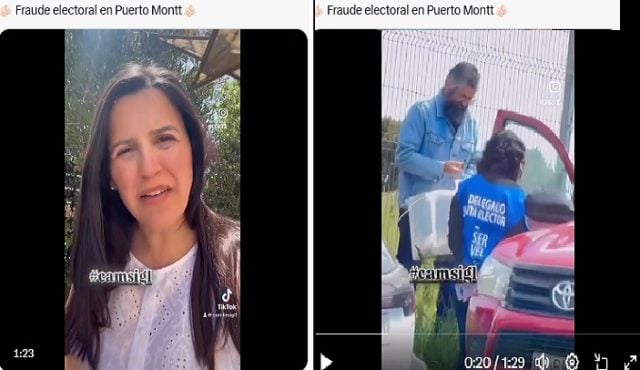
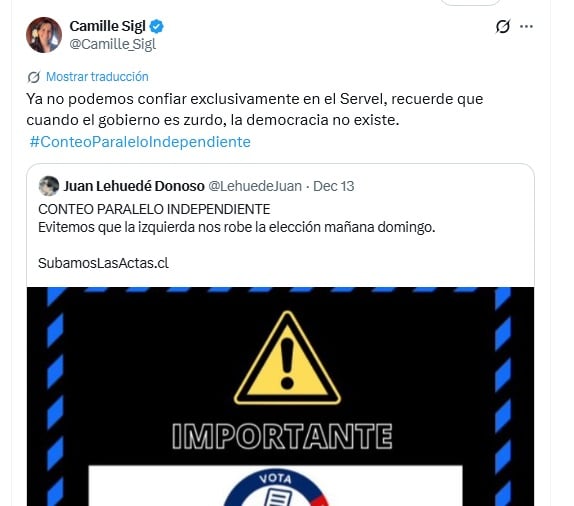
For instance, a video during the first round surfaced featuring Camille Sigl, a candidate for District 12 from the Libertarian National Party, who did not win and was among the disseminators of disinformation about alleged electoral fraud in Puerto Montt, which was categorically denied by Carabineros on the same Sunday, November 16. The fraudulent claim stemmed from assisted voting for a person with severe obesity who couldn’t enter the polling place.
However, the only serious irregularities formally reported involve various instances of alleged messages sent to clients by Lipigas, which explicitly call for voting for José Antonio Kast after the legal electoral propaganda period has ended, containing various xenophobic and hateful messages.
It should be noted that in this atmosphere, right-wing sectors have promoted a campaign and website called: “LET’S COUNT THE RECORDS,” created to “conduct a parallel count in these presidential elections,” which they have denounced as an instrumental and partial take on the elections.
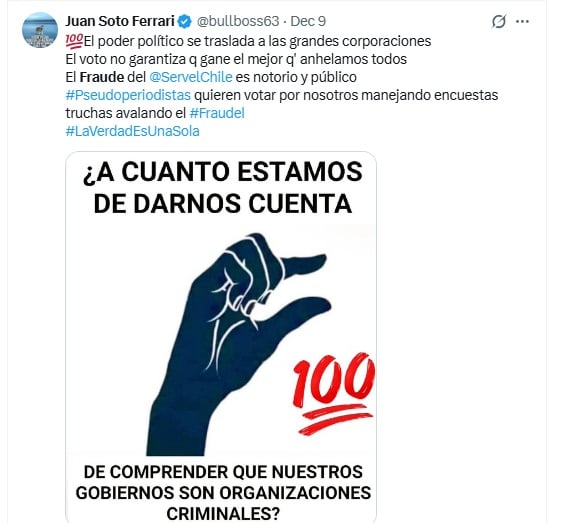
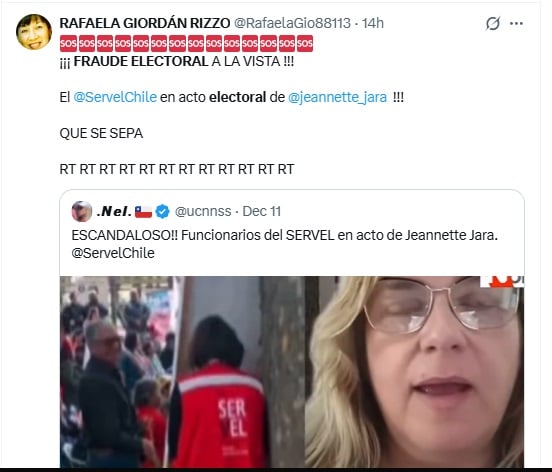
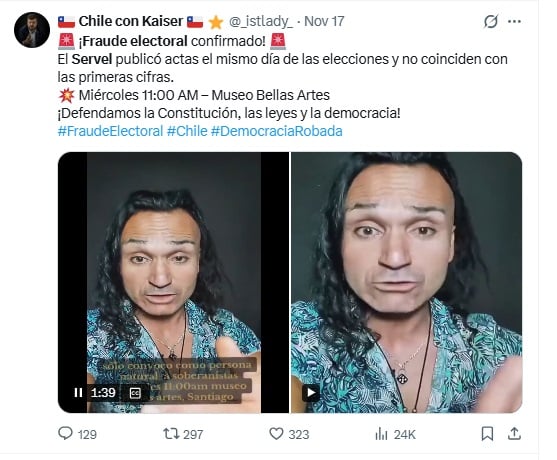
Some social media posts regarding the orchestrated “Electoral Fraud” campaign even include violent calls to “defend votes.”:
Hazte socio 👍
Con tu donación aportas a la sostenibilidad económica y existencia de este medio.
Elige cómo quieres aportar a la existencia y financiamiento colectivo de este medio!
 Reveniu
Relacionados
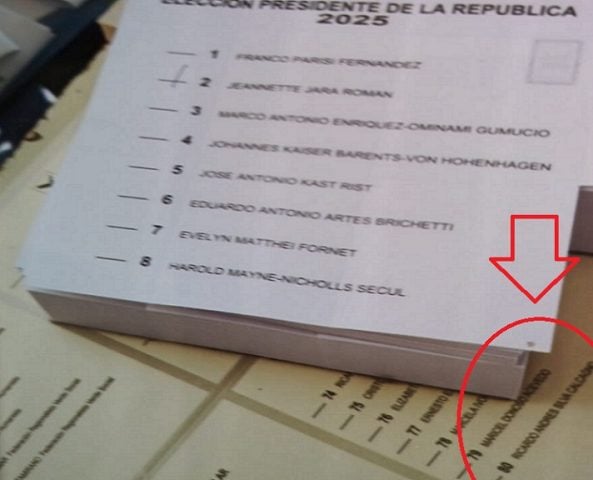
Right-Wing Accounts Spread False Claims of Electoral Fraud with Misleading Marked Vote Images
Hace 2 meses
Operación "Fraude Electoral”: la maquinaria de desinformación de la ultraderecha para erosionar la democracia chilena
Hace 4 semanas