Original article: Las AFP juegan al casino con el ahorro de los trabajadores: El neoliberalismo chileno al descubierto
By Leopoldo Lavín Mujica
A $700 Billion Gamble with Others’ Savings
On Sunday, October 25, El Mercurio dedicated two pages in its Economics and Business section to Pension Fund Managers (AFP), along with its editorial and a feature column, discussing the 10.4% drop of Fund E that occurred between January and September.
The report by María José Tapia and Soledad Vial, titled «The Technical and Legal Strategies Designed by the AFP,» is revealing: the paper not only informs about the industry’s strategy but also disseminates it without adequate critical examination.
What did the AFP bet on? Financial contracts known as interest rate swaps, negotiated with major banks.
The AFP agreed to charge a fixed rate while paying a variable rate tied to U.S. interest rates. If U.S. rates fell, they would profit; if they rose, they would incur losses. Ultimately, they bet on a decline in rates. However, rates increased, leading to costly consequences.
The nominal positions were around $700 billion—three times Chile’s pension savings—though that figure refers to the contract’s reference amount rather than fully disbursed cash.
This explanation is crucial, as El Mercurio’s editorial misrepresented the nature of the contracts, asserting that the AFP paid a fixed rate and received a variable one. This description implies profits when rates rise, directly contradicting the report’s details. This is not a minor issue: it alters the understanding of the operation and its associated risks.
El Mercurio: Two Pages for AFP, No Voice for Affiliates
Most voices cited in the report remained anonymous: “a manager,” “an executive,” “an administrator.” The AFP declined to give interviews, avoiding the emergence of anyone as “the symbol of losses.”
In contrast, there is no equivalent presence of members, retirees, or critical economists who could interrogate the system’s functioning. Managers speak; those bearing the consequences remain offstage.
The industry’s thesis resonates in the editorial: the value of the fund has dropped but not necessarily the pensions, with effects deemed «limited and, under certain conditions, nonexistent.» However, for those retiring now, this distinction can be critical.
The report mentions an individual who retired in January with a pension of $100,000, now receiving $98,200. According to the industry, those who retired by September 30 have seen their pensions decrease by about 3%.
AFP Habitat requested authorization from the Pension Superintendence to recalculate pensions for those who retired in the third quarter.
Worker Losses, Accountability of None
One manager acknowledged that had the bet been limited to thirteen years, Fund E would have dropped by 7% instead of 10%. “That extra 2% loss is a result of an investment decision we made with conviction,” he stated.
This statement is telling: it admits a conscious decision, yet the main cost does not fall on those who made it. The AFP reportedly lost about $20 million of its own resources due to matching funds, while affiliates lost approximately $7.7 billion.
The same manager noted that a proficient administrator makes correct decisions just over 50% of the time, while a poor one fares slightly worse. Thus, pension investments are described as an activity where mistakes are part of the game.
However, workers’ mandatory savings are not a voluntary gamble or a risk capital they can withdraw at will. This is money accumulated over decades to fund retirement.
The Casino Has Managers: Affiliates Bear the Risk
The manager complained that if compensation were enabled, claimants would line up as far as Coyhaique. Yet retirees receiving less than $353,000 monthly are already lining up, although not necessarily in court: they live each month with insufficient pensions.
The AFP possess legal teams to defend against protective measures and handle proceedings from the Superintendence. In contrast, affiliates must organize and bear their own costs to defend their rights.
The asymmetry is stark. Managers decide how to expose savings; workers absorb the losses and then must prove there was liability.
The industry portrays uncertainty as an inevitable market characteristic, while the system compels millions to entrust their contributions to private managers who cannot guarantee a dignified pension.
Pension Cynicism: When the Bet Fails, Workers Must Wait
The drop in Fund E, deemed the most conservative, reached approximately 10.39% between January and September 2026, following the AFP’s failed bets in derivative contracts linked to U.S. interest rates.
What is the Government and industry’s response? To ask workers nearing retirement to postpone their departure and wait for markets to recover.
The Government urged evaluating delays in retirement for several months, while the industry also spread recommendations to postpone decisions until market stability is restored.
Here lies the cynicism of Chilean neoliberalism in all its harshness: the AFP speculate with the mandatory savings of millions of workers, but when their bets fail, the bill is passed to those who have worked their entire lives. Managers decide; affiliates lose.
Administrators maintain power over someone else’s money; future retirees must sacrifice months of working life to try to recover losses. And all of this is presented as a natural consequence of the markets, as if there were no business decisions, regulatory responsibilities, or economic interests behind it.
Workers contribute mandatory savings, cannot freely access their funds, and when it comes time to retire, discover that they cannot trust the process without exposing themselves to the gambles of third parties. Neoliberalism turns a social right into a financial transaction, aging into a variable adjustment, and managerial irresponsibility into a problem each worker must resolve independently.
After decades of contributions, they expect workers to pay with their time for market recovery.
«Let the Issues Settle»: Patience Is Always Demanded from Retirees
León Fernández de Castro, president of the AFP Association, called for issues to “settle” on three occasions and urged a return to “rationality” twice, as if billions in losses were a wine needing rest.
He also maintained that pensions might not have dropped and defended that the Chilean system “is an example worldwide,” following a trip to London and Toronto to promote it. Meanwhile, losses are portrayed as a long-term phenomenon, and recoveries in October are celebrated with the argument that the fund “has already gained three points.”
Patience is demanded from those nearing retirement, not from those who made investment decisions. The supposed long-term nature of markets becomes an immediate burden for people who must pay rent, buy food, and cover medical expenses with limited income.
The Market Is Sacred; Claiming Rights Is a Political Interest
El Mercurio’s editorial acknowledges that the AFP might have acted “recklessly,” but immediately attributes criticism to a “political interest” and presents redistribution as an alternative the country has already dismissed.
Another editorial describes protests in France as expressions of a populace accustomed to demanding increasing benefits. Criticism of the AFP is thus framed ideologically, while the defense of individual capitalization is presented as economic neutrality.
In a column, Sebastián Claro claims that individual capitalization is “a longing in debt-burdened countries.” The UDI, founded by Jaime Guzmán, called for resignations. However, in this crisis, El Mercurio seems more loyal to the AFP than to UDI itself: its priority is to protect the legitimacy of the system, even when it acknowledges recklessness and workers bear multi-million dollar losses.
AFP: Mandatory Savings Transformed into Corporate Power
The AFP system was imposed in 1980 by José Piñera through Decree Law 3,500. Since then, obligatory contributions have turned into a flow of capital privately managed for the benefit of large economic groups.
This year, the AFP elected 28 directors in 21 public companies, including Falabella, Latam, and Parque Arauco. Workers’ money does not only finance their future pensions; it also grants economic and corporate power to those who manage it.
It is no surprise that the defense of the system occupies such a prominent position in media closely connected to business interests. When the savings of millions are converted into capital for large companies, the pension discussion ceases to be exclusively technical. It also becomes a power struggle, concerning the allocation of resources and who has the right to decide over them.
Boric Promised to Bury Neoliberalism; His Government Ended Up Supporting It
For two decades, the Concertación managed the individual capitalization model without dismantling its pillars. In July 2021, Gabriel Boric promised, “If Chile was the cradle of neoliberalism, it will also be its grave.”
In November 2022, his Government introduced a proposal that would end the AFP as the exclusive system axis, create a public investor to compete with private ones, and allocate all new employer contributions to social insurance.
However, the promise faded in political negotiations. The Government eventually accepted a reform that left the AFP intact and preserved their central role in managing pension savings.
The Jara and Marcel Reform: A Lifeline for the AFP
In January 2025, Jeannette Jara and Mario Marcel reached an agreement with the right-wing for a reform that did not create the public investor and left the AFP at the center of the system. Of the 8.5 points of new employer contributions, 4.5 are allocated to accounts managed by the AFP.
Jara promised to present the public investor separately; Marcel asserted that the priority was to “implement this reform.” The promised initiative never materialized.
The right controlled the Senate, but the Government celebrated the agreement as “an important milestone.” The outcome was a reform that modified elements of the system without altering its core power. The model’s continuity was not a technical inevitability; it was a political choice.
The Next Gamble Is Already Written in the Rules
Starting in April 2027, the reform will replace funds A-E with generational funds based on affiliates’ ages.
For those aged 55 to 60, close to retirement, the Superintendence of Pensions and the Technical Investment Council will set exposure horizons that, as described in the discussion, would be comparable to those behind the damage to Fund E.
The president of the AFP Association defended these timeframes: “If the regulation itself is adopting the same timelines, there must be a reason for it.”
The Technical Council is headed by Nicolás Eyzaguirre, a former Finance Minister under Ricardo Lagos and Michelle Bachelet. El Mercurio’s editorial itself acknowledges that the body did not respond to warnings.
The question is inevitable: if there were warning signals, why was there no timely action, and who is accountable for the exposure of the savings?
The Concertación Also Ensures Model Continuity
The failure is not limited to a financial operation or specific management. The Concertación maintained the system for twenty years; then, governments that promised to overcome it ended up preserving its essential structures.
Partial reforms have not eliminated the subordination of pensions to the logic of financial profitability or the power of administrators over mandatory savings.
The promise that private competition and professional management would yield better pensions coexists with the uncomfortable fact that workers bear the risk of investment decisions without controlling those decisions.
Neoliberalism demands individual responsibility from those with the least power while offering institutional protection to those managing capital.
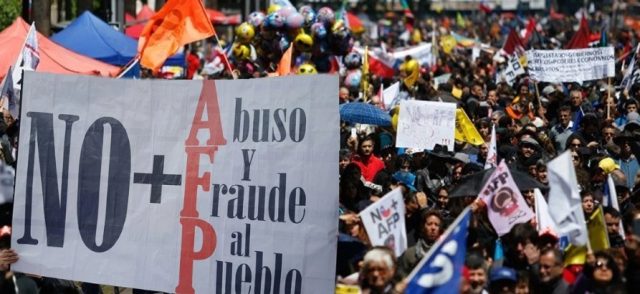
NO+AFP: Workers’ Savings Are Not a Casino
On October 18, Luis Mesina, spokesperson for NO+AFP, reiterated a fundamental demand: “The mandatory savings of millions of workers are not a casino.”
The campaign calls for audits, civil actions, and investigations by the Superintendence, with decisions and responsible parties identified in court. It is not enough for authorities to express regret over losses or suggest waiting for market recovery.
Manuel Riesco, vice president of CENDA, estimates that since 1981, workers’ net savings have earned merely 0.6% annually in dollars, proposing an end to mandatory contributions into individual accounts and allowing voluntary returns to the IPS.
The October 2019 slogan—NO+AFP—thus finds new arguments: the crisis is not an isolated anomaly but a manifestation of a system that turns social security into financial business.
The Only Speculation That Disturbs El Mercurio Is Criticism of the AFP
The editorial warns that “speculation must be avoided,” yet targets criticisms of the AFP, not the financial bets made with mandatory savings.
The paper calls for prudence from those denouncing, while downplaying the risks taken by managers and echoing industry arguments.
Financial speculation appears as a technical decision; the demand for accountability is seen as a political maneuver.
The question is no longer who miscalculated interest rates. It’s who holds the power to gamble away the future of millions without facing accountability commensurate to the consequences.
Leopoldo Lavín Mujica
Obtén tu Pasaporte y apoya a El Ciudadano
Elimina la publicidad, accede a contenido exclusivo y sé parte de la comunidad.
Cancela en cualquier momento · Sin permanencia
Artículos Relacionados

Marcel Blames Pension Fund Managers for E Fund Losses and Advocates Compensation for Affected Members
Hace 7 días