
Original article: Desocupación escala a 8,4%: crece la búsqueda de empleo, no la contratación
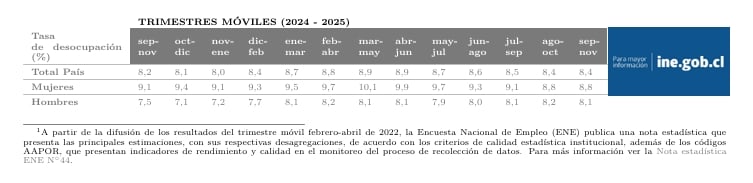
The unemployment rate in Chile reached 8.4% during the September to November 2025 quarter (SON 2025), marking a rise of 0.2 percentage points (pp) over the past year. This increase, reported by the National Employment Survey (ENE) from the National Institute of Statistics (INE), reflects a situation where job searches have not matched the pace of hiring.
According to the report, the increase is attributed to a growth in the labor force (1.5%) that outpaced the increase in employed individuals (1.2%).
Specifically, the total number of unemployed persons rose by 4.0% year-on-year, affected by those who were previously laid off (2.8%) and first-time job seekers (16.2%), as detailed in statistical bulletin No. 326.
Women Face Higher Unemployment but Report Better Employment Indicators
The breakdown by gender reveals a contrasting reality. The female unemployment rate stood at 8.8%, while the male rate was 8.1%. However, the year-on-year trend shows opposite paths: unemployment among women decreased by 0.3 pp, while it increased by 0.6 pp among men.
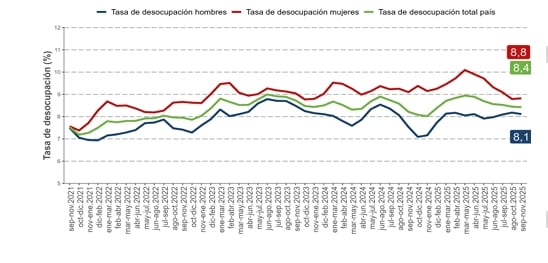
This divergence is explained by the dynamics of participation and employment. In the case of women, the growth of 2.0% in the labor force was less than the 2.3% increase in employed women, meaning more women found jobs than those who joined the job search, resulting in a decrease in the unemployment rate. Additionally, the number of unemployed women contracted by 1.1%, spurred by a reduction in layoffs (-2.2%).
Conversely, for men, the increase of 1.1% in the labor force exceeded the 0.4% increase in employed men, pushing the unemployment rate higher. Unemployed males increased by 8.8%, influenced by those who were laid off (7.3%) and first-time job seekers (27.4%).
For women, participation and employment rates were at 53.0% and 48.3%, respectively, reflecting increases of 0.6 pp and 0.7 pp in each case. Those outside the labor force decreased by 0.3%, influenced by habitual inactive individuals and new entrants.
In contrast, the participation rate for men stood at 71.3%, an increase of 0.2 pp, while the employment rate reached 65.5%, down by 0.3 pp during this period. The number of men not participating in the labor force grew by 0.5%, exclusively influenced by habitual inactive individuals.
Employment Growth Driven by Services and Informal Work
The total number of employed individuals grew by 1.2% over the year, with significantly stronger performance among women (2.3%) compared to men (0.4%).
The sectors leading this expansion were administrative and support services (31.0%), transportation (5.5%), and information and communications (13.6%). Conversely, declines were noted in public administration (-7.8%), manufacturing industry (-2.3%), and households as employers (-2.2%).
By occupational category, the increase was observed in informal wage earners (6.2%) and self-employed individuals (1.1%).
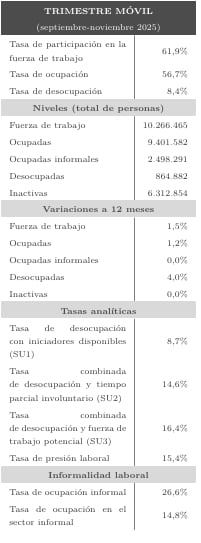
This statistic is directly linked to the informal employment rate. The rate of informal employment was recorded at 26.6%, marking a slight decline of 0.3 pp over the year.
According to the INE report, informality more heavily impacts women (28.4%) compared to men (25.2%). It also highlighted that the administrative and support services sector significantly contributed to informal employment (27.6%), while the manufacturing industry experienced the steepest fall (-6.6%).
Unemployment in the Metropolitan Region
In the Metropolitan Region, the unemployment rate for the September to November 2025 quarter reached 8.9%, rising by 0.3 pp over the year. During the same period, the estimate for the total employed population grew by 1.2%, primarily influenced by the administrative and support services sector (50.7%) and information and communications (13.5%).
Other Relevant Indicators
-Absent Employees: The number of employed individuals absent from work (representing 4.9% of the total) decreased by 15.0%, equivalent to 82,105 people.
-Hours Worked: The total volume of effective hours worked expanded by 2.3%, with the average weekly hours at 36.8, highlighting a significant gap between men (39.0 hours) and women (33.9 hours).
-Seasonally Adjusted: The seasonally adjusted unemployment rate was 8.6%, increasing by 0.2 pp from the previous mobile quarter.
Hazte socio 👍
Con tu donación aportas a la sostenibilidad económica y existencia de este medio.
Elige cómo quieres aportar a la existencia y financiamiento colectivo de este medio!
 Reveniu
Relacionados

Mexico Ranks as the Second Country with Lowest Unemployment in the World by 2025, While Chile Stands at 16th
Hace 3 días