Original article: U. de Chile despide a uno de sus maestros: Falleció Gonzalo Díaz Cuevas, Premio Nacional de Artes Plásticas 2003
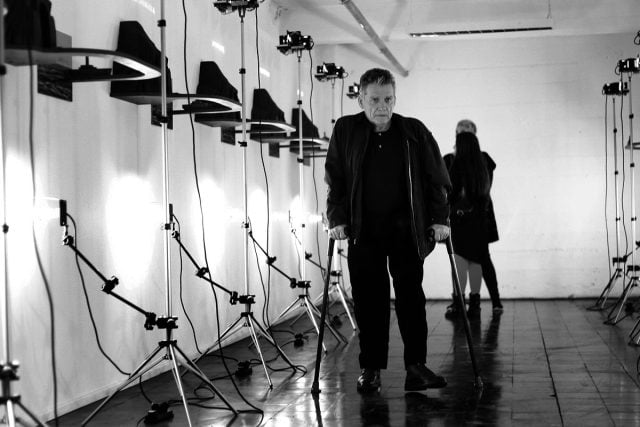
The academic, cultural, and artistic worlds are in mourning. On December 11, visual artist and National Prize for Visual Arts 2003 and professor at the University of Chile, Gonzalo Díaz Cuevas, passed away. On the same morning, he had been announced as the recipient of the 2025 Juvenal Hernández Jaque Rector’s Medal in Arts, Letters, and Humanities.
«Gonzalo Díaz was a giant in art, academia, and life. Respected and beloved, honest and courageous, he embodies the best of the University of Chile. With overflowing artistic talent that he generously poured into teaching and creation, he also knew how to build institutions and pave the way forward,» stated rector Rosa Devés upon hearing the news.
Dean of the Faculty of Arts, Fernando Carrasco, remarked that Gonzalo Díaz «was an artist, an academic, and a central figure for our Faculty and our University. His critical, avant-garde, and resilient work during tough times paved the way for countless young artists who passed through his classes and core teachings in our Department of Visual Arts.»
«With deep sorrow, we bid farewell to someone I believe will be remembered as one of the most prolific and significant artists of the last fifty years in our contemporary history,» added Professor Carrasco.
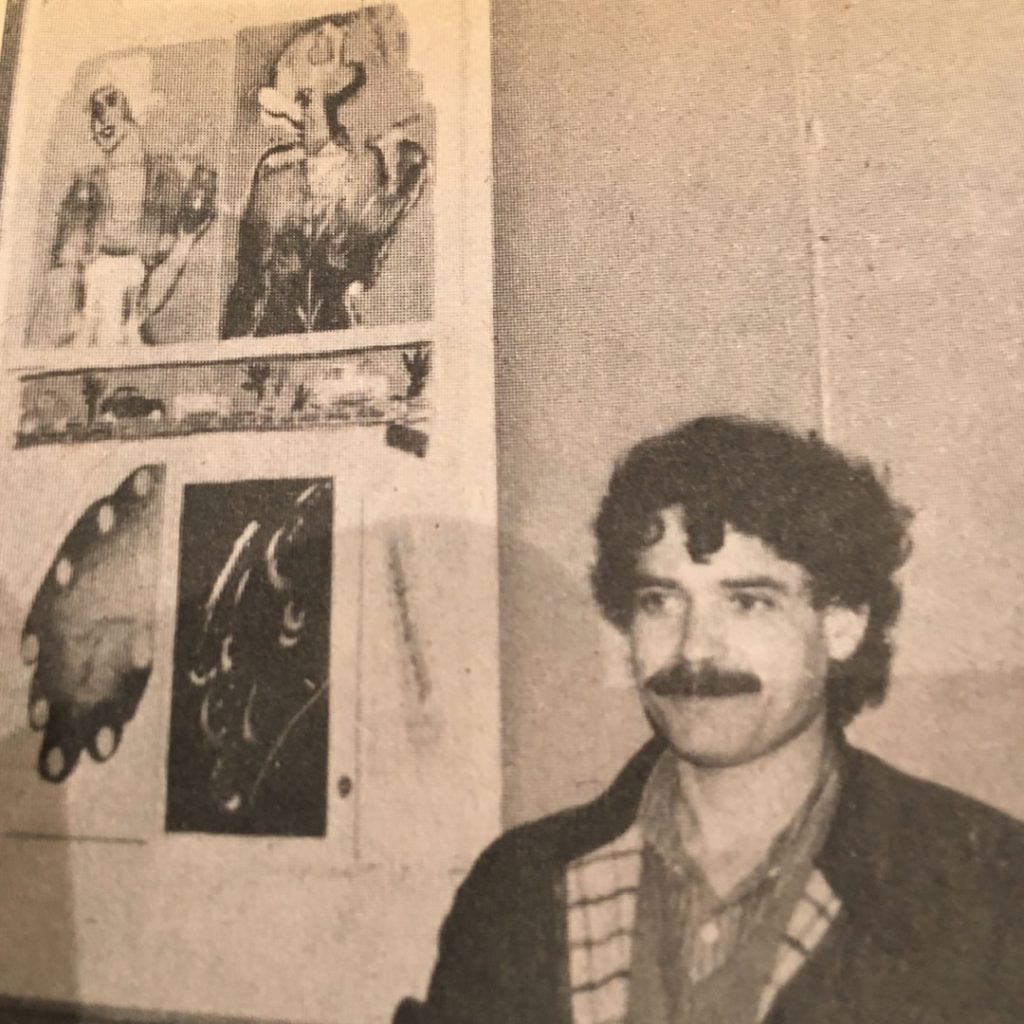
From the University of Chile, it was announced that the artist’s wake will take place starting Friday, December 12, from 12:00 PM to 8:00 PM at the MAC in Parque Forestal. It will continue on Saturday with a farewell ceremony open to the public, led by his family, the University, students, and loved ones, at 12:30 PM.
Legacy
In a constant effort to preserve his thoughts and legacy, Professor Díaz had recently published the volume «Writings 1980–2020 and Texts in Work,» a comprehensive publication of over 500 pages, edited by Consuelo Rodríguez under the Metales Pesados publishing label.
One of his last public milestones was presenting his digital archive, which contains over 240 works, 169 exhibitions, and 350 documents and publications as a space for collaborative research.
Regarding this collection, presented to the public in January 2025, the National Prize laureate stated that the goal is to «disseminate it in various areas and engage in dialogue with other archival or research initiatives. The connection with students and academics at the University of Chile is also very important.»
Life and Work Related to the University of Chile
Gonzalo Díaz was born in Santiago on March 13, 1947.
Educated at the School of Fine Arts of the University of Chile from 1965 to 1969, he studied under José Balmes, Rodolfo Opazo, Alberto Pérez, and Adolfo Couve.
He graduated with a degree in Art, specializing in Painting. He continued his studies in 1980 at the Università Internazionale dell’arte in Florence, Italy, where he shared a workshop with national artist Francisco Smythe.
Later, in 1987, he received a fellowship from the Guggenheim Foundation through which he developed the project “Marking the Territory or Introduction to the Chilean Landscape.”
In 1969, he began as an assistant in the Painting Workshops of the Faculty of Arts at the University of Chile, becoming a Full Professor in 1975. In 1977, he participated in founding the Institute of Contemporary Art, where he taught Painting Workshops.
Díaz was also a candidate for Rector in 2014 and served as the first president of the Evaluation Council, which met for the first time in 2006.
The Conceptual Art of a Generation
Belonging to a generation that sought to express itself conceptually, using new supports and forms of expression, Gonzalo Díaz burst onto the national painting scene with his “Sentimental History of Chilean Painting,” with the iconic image of the female figure from the Klenzo detergent bottle, reproduced and altered in its presentation.
Since then, he has continued to seek new forms of expression, combining his individual creativity with ongoing engagement in teaching at the universities of Chile and Arcis.
Under that paradigm, he presented groundbreaking proposals, incorporating different explorations beyond formalism.
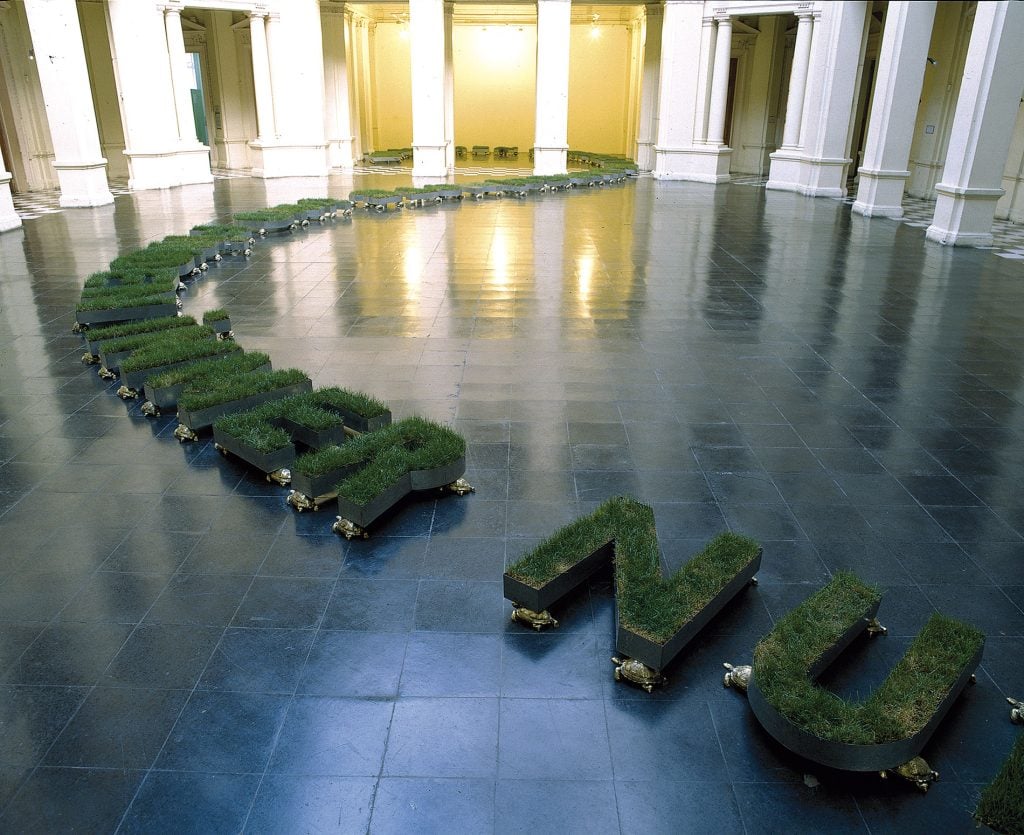
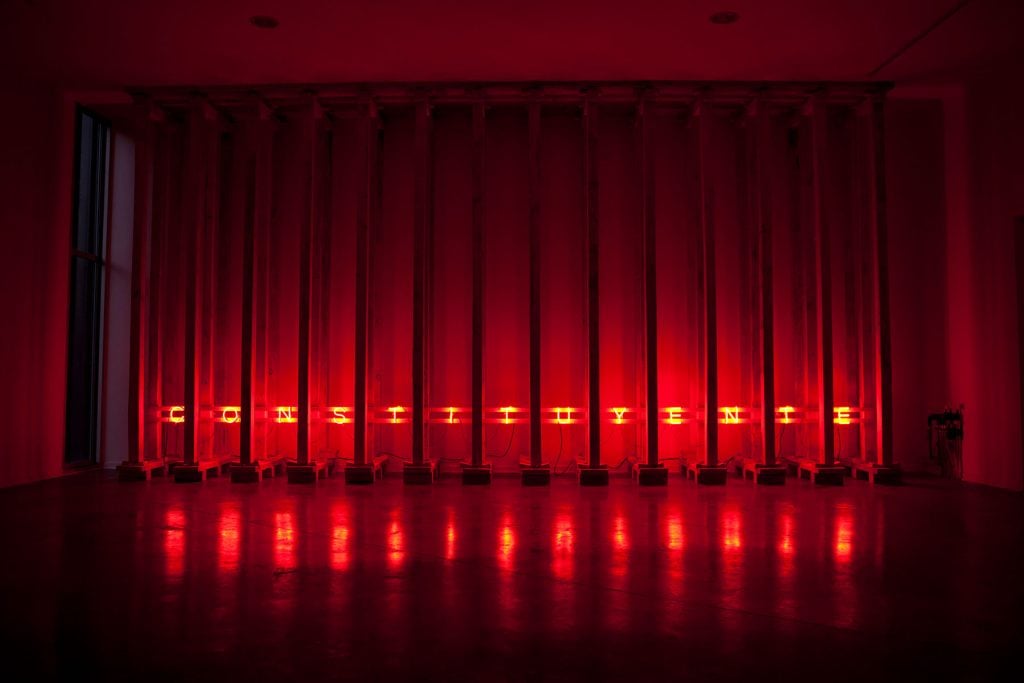
For example, at the end of 2001, he exhibited at the Museum of Contemporary Art the work “Treatise on Human Understanding,” a large installation based on a phrase by the German poet and philosopher Novalis: “We seek the unconditional everywhere and always find things.” The installation occupied the museum’s hall and featured letters containing grass in their cavities, supported by metal turtles (205 in total).
Awards and Honors
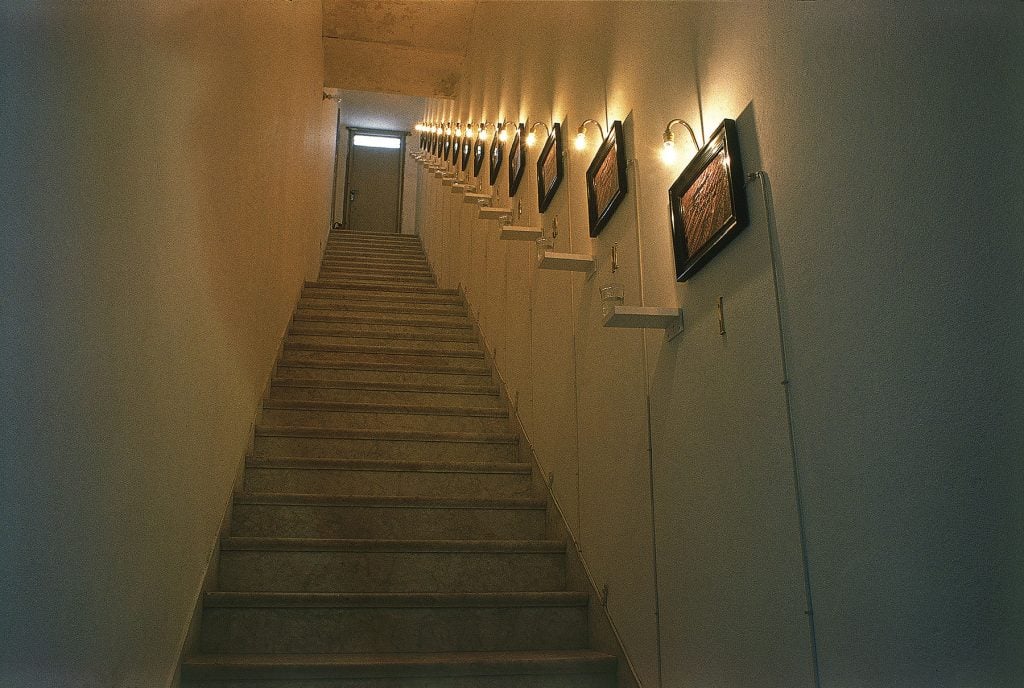
Among the honors received, in addition to the National Prize awarded in 2003, Gonzalo Díaz received the Merit Prize, CRAV Competition, Museum of Contemporary Art (1974); the Plastic Creation Competition with the project “Paradise Lost,” sponsored by the Scientific Development Service of the University of Chile (1978); the Grand Prize of the VI Competition of the National Securities Broker with his work “The Children of Happiness or Introduction to the Chilean Landscape” from the National Museum of Fine Arts (1980); the First Prize Chile-France Competition, Chilean-French Cultural Institute (1983); the Guggenheim Foundation Art Grant in the USA (1987); and the Altazor Prize for the installation “United in Glory and in Death” at the National Museum of Fine Arts (2000).
You can learn more about the life and work of Gonzalo Díaz at the Chilean Visual Artists portal of the National Museum of Fine Arts.
El Ciudadano
Relacionados
Héctor Noguera, Renowned Chilean Theatre Master and 2015 National Prize Winner, Passes Away
Hace 3 meses
STELLA TERRAL: A Tribute to Renowned Chilean Poet Stella Díaz Varín at Teatro del Puente
Hace 3 meses
"Balmes Law": Bill Advancing in Senate to Establish Intellectual Property Protection for Visual Arts
Hace 3 semanas
Lafamiliateatro Launches New Pathways in International Theatre with Presence at Teatro a Mil Festival
Hace 2 semanas