Original article: Departamento de Estado de EEUU reconoce trata de personas con fines de trabajo forzoso en la agricultura y acuicultura chilenas
US State Department Identifies Forced Labor in Chilean Agriculture and Aquaculture
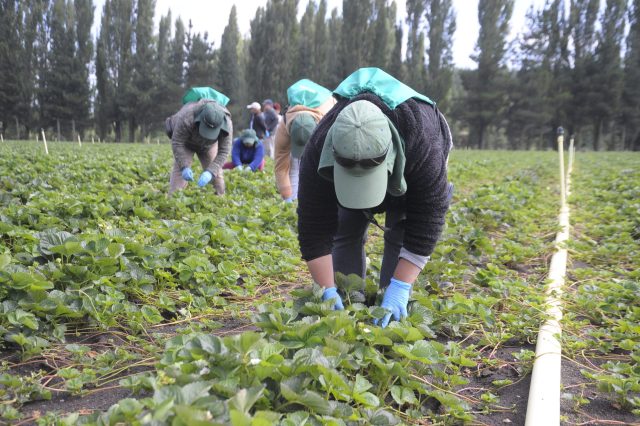
The United States Department of State has released its 2026 Trafficking in Persons Report, stating in its chapter on Chile that «traffickers exploit adults and children in forced labor in mining; agriculture, including the harvest of berries; aquaculture; construction; street vending; domestic work, and the hospitality, restaurant, and garment sectors.»
This acknowledgment is not isolated. Aquaculture has been highlighted in Chile’s profile in the report since at least 2023, and berry harvesting was added in 2025.
For Fundación Libera and the Ecoceanos Center, this reiteration confirms the documentation provided by workers, unions, and civil society organizations regarding forced labor in the salmon farming industry and export agriculture.
This evidence was presented by Fundación Libera and Ecoceanos to the Office of the United States Trade Representative (USTR) during its Section 301 investigations concerning forced labor in Chile (files USTR-2026-0265 and USTR-2026-0266).
«The State Department officially recognizes what we have documented before the USTR: forced labor exists in Chilean agriculture and aquaculture. The Chilean State can no longer treat this as a mere accusation from civil society; it is an official diagnosis that requires concrete responses,» stated Carolina Rudnick Vizcarra, president of Fundación Libera.
Chile Maintains Level 1 Status
The report keeps Chile at Level 1 (countries whose governments fully meet the minimum standards of the U.S. Trafficking Victims Protection Act – TVPA – for the elimination of trafficking in persons), noting increased investigations, prosecutions, and identified victims. However, the same document reveals significant gaps regarding forced labor:
No Convictions for Forced Labor. In 2025, there were 816 investigations into trafficking: 644 for commercial sexual exploitation of minors (ESCNNA), 109 sexual trafficking cases, and only 62 for labor trafficking (7.6%). Fourteen people were prosecuted for forced labor, but all 34 convictions were for sexual exploitation.
Prosecutors Unaware of Forced Labor Problems: The report states that police officials, prosecutors, and the judicial sector lack a thorough understanding of human trafficking, and some local prosecutors fail to recognize the crime, particularly forced labor, nor do they gather sufficient evidence to support it. Deficiencies in evidence collection have also led authorities to pursue trafficking offenses under other articles of the Penal Code that impose lesser penalties than those provided in Article 411.
Unregulated Labor Recruiters: The report indicates that Chile does not regulate recruiters or hold them accountable for fraudulent recruitment, a critical link in the mediation and subcontracting processes in agriculture and salmon farming.
Specialized Capacity Lacking in the South: Specialized units of the PDI (Investigative Police) are located in Arica, Iquique, and Santiago; none in the regions where agriculture and salmon farming are concentrated. There are also no shelters for male victims.
Victims Without Support: Only 58 of the 245 identified victims (about 24%) received services, and there are limited spaces, challenges for specialized care, and territorial gaps in service availability, including a lack of shelters for male victims.
Punishments That Do Not Deter: The report outlines a consistent pattern of light and suspended sentences for crimes.
Policy Without Support: The National Action Plan Against Trafficking 2023–2026 has not been approved by the Presidency, and the Intersectoral Committee on Trafficking in Persons does not have its own budget.
«Processing only 14 people for forced labor, with none convicted, shows that the problem is not a lack of cases, but a system unprepared to recognize them. Until forced labor is an autonomous crime in Chile, it will continue to slip between criminal categories,» warned Carolina Rudnick.
Gaps in Labor Legislation and Government Inaction
Fundación Libera and the Ecoceanos Center have also raised concerns about the lack of labor legislation in high-risk sectors, which undermines the government’s claims about having strong legislation and institutions in place.
«In the same year that the State Department recognizes forced labor in Chile’s aquaculture, the government withdrew regulations that were supposed to enforce protections for subcontracted divers in salmon farming, according to Law 21.789,» questioned Juan Carlos Cárdenas, director of Ecoceanos.
«Without regulations, the law remains on paper, and contracting companies continue without enforceable obligations. Divers are exposed to excessive working hours, forced work during closed ports, and fear of retaliation if they refuse, indicators of forced labor according to the ILO,» he added.
Additionally, between 2013 and 2026, 91 worker deaths have been documented in this mega exporting industry: «Every month of delay deepens the lack of protection and the risk of exploitation; we demand the immediate return of the regulations to the General Comptroller’s Office,» stated the Ecoceanos director.
Requests from Fundación Libera and Centro Ecoceanos to the Chilean State
These are the proposals put forward by both organizations:
1) Criminalize forced labor according to international standards.
2) Strengthen sectoral labor legislation in high-risk forced labor sectors: Expedite the regulation of Law No. 21.789 (Diving Law), which protects subcontracted divers in salmon farming, and repeal the directive by the Labor Directorate that prevents undocumented migrants from filing complaints.
3) Implement a national prohibition on the importation of forced labor.
4) Eliminate restrictions on freedom of association and collective bargaining.
5) Enhance compliance with labor legislation.
6) Include transparent monitoring mechanisms and binding obligations in labor agreements within trade treaties.
7) Involve expert civil society organizations and victims in the design and implementation of public policy.
8) Create specialized investigative and prosecutorial capacity in the southern regions and designate prosecutors specifically for trafficking cases.
9) Ensure services and accommodations for all victims, including men and those outside the capital, and guarantee effective payment of reparations.
10) Approve and fund a new National Action Plan Against Trafficking, with its own budget for the Intersectoral Committee.
11) Approve and fund the National Action Plan Against Forced Labor, with its own budget for the Ministerial Advisory Commission for the Elimination of Forced Labor.
We will continue to provide updates. Cover Photo: Reference.
Obtén tu Pasaporte y apoya a El Ciudadano
Elimina la publicidad, accede a contenido exclusivo y sé parte de la comunidad.
Cancela en cualquier momento · Sin permanencia