Original article: Vietnam y su plan para girar de exportador de tierras raras en bruto a refinador en suelo nacional
For years, Vietnam has navigated a challenging position in the geopolitics of critical minerals: it holds the second-largest rare earth reserves in the world but exports nearly all its crude ore, primarily to China. Now, Hanoi aims to change this narrative. The Ministry of Industry and Trade has finalized a draft decree that, if enacted, would prohibit the export of unprocessed rare earth ore and 16 other strategic minerals, requiring that any sale abroad meets strict deep processing thresholds in Vietnam. This draft, submitted to the Ministry of Justice for review on October 8, is not yet law. However, its existence signifies a seismic shift in Hanoi’s strategy: moving from a raw materials supplier to a significant player in the global value chain.
The Draft: 17 Minerals Under Lock
The document, titled “List of Strategic and Important Minerals Permitted for Export and their Processing Levels”, identifies 17 of the 19 minerals on Vietnam’s strategic list. It includes rare earths, tin, tungsten, antimony, copper, bauxite, titanium, lithium, iron, manganese, molybdenum, nickel, cobalt, chromite, anthracite coal, apatite, and graphite. Uranium, thorium, and gold are excluded from this specific regime.
The rule is simply formulated but radical in effect: only products that have reached the specified deep processing level for each mineral may be exported. Direct export of raw ore or concentrates is prohibited. For tin, for instance, refined metal is required, even in ingots. Tungsten must be processed into ammonium paratungstate (APT) or tungsten oxide. Copper is allowed only in refined cathodes or plates.
The case for rare earths is even more restrictive. They do not follow the general rule of the draft, which allows the export of any product that surpasses a processing threshold. Rare earths have a special management mechanism: they may only leave the country in one of five forms: individual rare earth oxides (separated), rare earth metals, alloys, alloy powders, or permanent magnets. Minerals, concentrates, and intermediate products are strictly prohibited.
No Transition, No New Procedures
Two details of the draft reveal the urgency with which Hanoi wants to implement this shift. First, there is no transition period. The criterion for determining if a shipment is governed by the new policy is the time of customs declaration. Contracts signed prior to the law’s enactment are not automatically protected. Second, the text does not create new administrative procedures, a concession to the exporting community that does not mitigate the impact of the fundamental prohibition.
The Gap Between Paper and Factory
According to the U.S. Geological Survey (USGS), Vietnam possesses an estimated 22 million tons of rare earth oxides, roughly half of China’s reserves and more than any other country. Mining production has skyrocketed tenfold in recent years, increasing from 400 tons in 2021 to 4,300 tons by 2025, propelling Vietnam to the sixth-largest global producer, up from tenth place in 2021.
However, this explosive growth conceals a paradox that the draft seeks to rectify. Vietnam lacks a single operational industrial plant capable of refining ore into high-purity rare earth oxides (≥95%), the minimum standard for export and use in advanced technology. Current activities focus on extraction and primary processing. As Professor Tran Dai Lam from the Institute of Materials Science at the Vietnam Academy of Science and Technology states: “A country that possesses rare earths but only extracts and exports them as primary ore or concentrates is selling the lowest part of the value chain.”
The primary beneficiary of this dynamic has been China. Chinese customs data shows that imports of rare earth elements and concentrates from Vietnam doubled to nearly 12,000 tons in the last recorded year. Vietnam also imported rare earths to process and re-export, an anomaly the new framework seeks to eliminate.
The Legal Framework is Already in Progress
The Ministry of Industry and Trade’s draft is supported by a broader legislative change: the Amended Law on Geology and Minerals, approved by the National Assembly on December 11, 2025, and effective from January 1, 2026. This law formally classifies rare earths as a special strategic resource under strict state supervision and prohibits the export of raw ore. The regulation stipulates that only designated or authorized entities by the Government can carry out exploration, extraction, and processing activities for rare earths, with the State centrally managing geological data.
The Ministry of Industry’s draft operationalizes this legal prohibition, defining what is meant by “deep processing” for each mineral and closing the regulatory loophole that previously allowed the export of concentrates.
The Global Industry is Already Moving
Despite the draft not yet being enacted, the international private sector is already positioning itself. In March 2026, Australian Lynas Rare Earths—the largest rare earth producer outside of China—signed a framework agreement with South Korean LS Eco Energy to build a rare earth metal production facility in Vietnam. The facility will convert rare earth oxides into metals, initially prioritizing samarium, and produce neodymium-praseodymium metals (NdPr) and heavy elements like dysprosium and terbium, critical inputs for permanent magnets in electric vehicles and wind turbines. Both companies signed convertible instruments worth approximately 30 million Australian dollars each as a signal of long-term commitment.
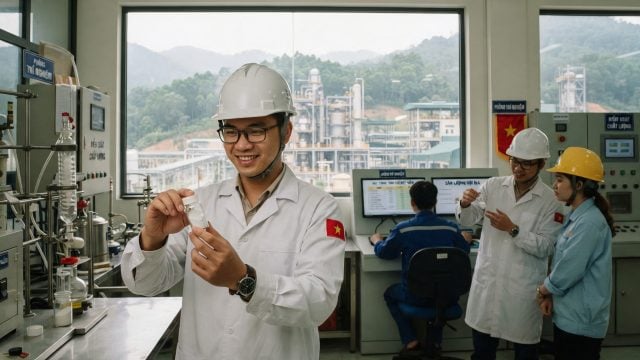
Simultaneously, Hanoi has activated a regulatory sandbox mechanism to test semi-industrial-scale refining technology. In September 2026, the Hanoi People’s Committee authorized the Construction Consulting and Mining Technology Joint Stock Company to execute a pilot project to produce total rare earth oxides with purity above 95% from ore sourced from Dong Pao mine in Lai Chau province. The plant is designed for a capacity of 100 kilograms of ore per hour and a maximum of 100 tons of processed ore, with an 18-month testing period. The project is financed 80% by the company’s own resources.
The Challenge: Technology, Not Ore
Prime Minister Pham Minh Chinh himself has acknowledged that the central challenge is not a lack of resources but the absence of technological capacity to convert those resources into value. In a meeting of the Government’s Standing Committee in January 2026, Chinh emphasized the need to develop the rare earth industry to ensure national strategic autonomy, prioritizing deep processing, advanced technology transfer, public-private collaboration, and infrastructure development.
The official roadmap, however, is ambitious. The Government has planned to raise annual rare earth mineral production to 2 million tons by 2030, a goal that would multiply current production by more than 450 times. Achieving this would require not only massive investment in separation and refining plants but also the training of specialized human capital and resolution of regulatory bottlenecks that analysts believe still persist despite legislative advances.
What Is at Stake
If the draft is enacted without changes, Vietnam will cease to be a marginal supplier of concentrates and instead become a gatekeeper of its own subterranean resources. Countries that currently import Vietnamese raw ore—China primarily—will have to adapt: either purchase already processed products or establish refining capacity in Vietnam. For Western nations looking to diversify their rare earth supply chains away from China, Vietnam’s maneuver presents both an opportunity and a warning: Hanoi is not willing to be a mere raw material supplier in that strategy. It aims to be a partner and intends to retain the added value.
The draft is now in the hands of the Ministry of Justice. Its approval—or modification—will determine whether Vietnam successfully bridges the gap between the 22 million tons that lie beneath its soil and the magnets, alloys, and metals that the world requires.
The Citizen
Obtén tu Pasaporte y apoya a El Ciudadano
Elimina la publicidad, accede a contenido exclusivo y sé parte de la comunidad.
Cancela en cualquier momento · Sin permanencia