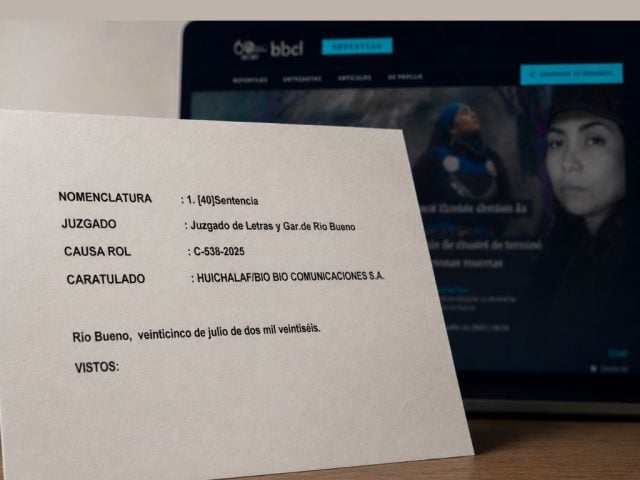
For the first time since the implementation of the Zamudio Law, a Chilean court has condemned a media outlet for arbitrary discrimination arising from journalistic coverage. The Río Bueno Court of Letters and Guarantees accepted the action brought by Machi Millaray Huichalaf against Radio Bío Bío, challenging a series of editorial decisions included in two publications by BBCL Investiga.
The ruling does not prevent the press from investigating matters of public interest nor does it challenge the potential to report on the actions of a traditional authority. Rather, the issue, according to the court, lay in the manner in which the reports were constructed: the nickname assigned to Huichalaf, the repeated use of quotation marks in reference to her status as a machi, and a caption that could lead to a negative valuation of her.
In addition to declaring that arbitrary discrimination occurred, the sentence ordered the correction of both publications, the inclusion of an explanation about the changes, the training of most of the journalistic team, and the payment of a fine of ten Monthly Tax Units. These obligations will take effect once the ruling becomes final.
Key Aspects of the Ruling Against Radio Bío Bío
The Río Bueno Court of Letters and Guarantees declared that Radio Bío Bío engaged in arbitrary discrimination against Machi Millaray Huichalaf in two reports published by BBCL Investiga in September 2025. This represents the first ruling applying the Zamudio Law to a media outlet for journalistic coverage.
-
Two reports were subject to the ruling.
The ruling pertains to “The ‘Machi’ of Sacrifices: The Dark Plot Behind the Ritual That Ended with Two Deaths” and “Trip to the Regime and Shift to Environmental ‘Struggle’: The Networks Woven by the ‘Machi of Sacrifices’”. -
The outlet must remove expressions deemed discriminatory.
Radio Bío Bío will need to replace the nickname “the Machi of Sacrifices” with “Machi Millaray Huichalaf,” eliminate the quotation marks used around the word machi, and modify the caption “A Lost Woman.” -
The corrections must be publicly explained.
The media must add a note at the bottom of both reports to inform that the changes were mandated by a court ruling due to the discriminatory effect of the questioned expressions. -
The journalistic team must receive training.
At least 90% of the contracted, freelance, or part-time journalists must participate in a session about discrimination, freedom of expression, and the criteria set out in the ruling.
Importantly: The ruling is not yet final and can still be appealed.
Zamudio Law Against Radio Bío Bío: The Two Questioned Reports
The court analyzed two pieces published during September 2025.
The first, released on September 14, was titled “The ‘Machi’ of Sacrifices: The Dark Plot Behind the Ritual That Ended with Two Deaths”.
The second appeared on September 28 under the title “Trip to the Regime and Shift to the Environmental ‘Struggle’: The Networks Woven by the ‘Machi of Sacrifices’”. Both were prepared by a journalist from the BBCL Investiga unit.
The publications addressed Huichalaf’s background and a healing ceremony held in August 2025 at the Pilmaiquén River, during which two people died. Radio Bío Bío contended during the trial that these were highly significant public events and that their coverage constituted a legitimate exercise of the freedom to inform.
The judge did not deny the public interest. In fact, he stated that Huichalaf’s identity as a woman, a Mapuche authority, or environmental defender did not exclude her from scrutiny or prevent criticism of her actions. What was evaluated was whether the resources used to present that information created a discriminatory treatment.
First Key: The Nickname That Must Disappear
One of the primary measures ordered is to eliminate the expression “the machi of sacrifices” from digital platforms and replace it with “Machi Millaray Huichalaf”.
The ruling considers that the nickname, created and repeated by the media itself, did not serve merely as a description. Coupled with the other details presented in the reports, it contributed to constructing a stigmatizing representation of the Mapuche-Williche authority.
The sentence did not order the complete elimination of the investigations. It specified corrections for the specific expressions considered discriminatory, marking a significant difference from what the plaintiff initially requested.
Second Key: Radio Bío Bío Must Remove the Quotation Marks from the Word Machi
The second order concerns the repetitive use of the word machi within quotes.
According to the court, this repetition could cast doubts on Huichalaf’s legitimacy as a spiritual authority, especially when combined with other criticisms present in the publications.
The ruling noted that whenever the audience encountered that designation in quotes, and related it to the other details of the narrative, it produced an accumulative effect that undermined her credibility and could discourage her public participation.
For this reason, Radio Bío Bío must eliminate this graphic resource from the questioned publications.
Third Key: The Caption “A Lost Woman” Must Be Changed
The ruling also ordered the substitution of the caption “A Lost Woman”, used in one of the reports.
In its place, the description should be used: “In 2013 she presented herself saying she was lost and looking for some neighbors”. The new formulation retains the detail the media intended to communicate, but removes the generalization used to present that episode.
The court determined that reporting on that situation did not in itself constitute discrimination. The issue fell on how it was highlighted through an ambiguous phrase, susceptible of projecting a broader valuation of the woman portrayed.
Fourth Key: The Corrections Must Be Publicly Explained
Radio Bío Bío cannot make the changes quietly.
The ruling stipulates that a note must be added at the bottom of the publications to inform that the modifications were made in compliance with a court ruling that determined the questioned expressions produced a discriminatory effect.
It must also detail the imposed fine and, once made, the date of payment. This measure aims to ensure audiences understand why the original texts were altered and directly ties the redress with the public impact of the reports.
«Radio Bío Bío is ordered to publish, at the bottom of the aforementioned publications, that the present ruling has compelled it to modify the previously indicated expressions, considering that they produced a discriminatory effect against Machi Millaray Huichalaf, stating that it is perfectly common and possible in the context of Mapuche culture that ancestral authorities are not accepted by all members of the community they intend to serve. It must also indicate the fine that has been paid and the date when the payment was made,» indicates the ruling.
The Ruling Examines the Result, Not Just the Intent
A central reasoning of the ruling is the difference between having the intent to discriminate and producing a discriminatory effect.
During the trial, it was not established that Radio Bío Bío acted with the deliberate purpose of discriminating against Huichalaf. However, the court concluded that this did not prevent the application of the Zamudio Law if the language, designations, and editorial structure objectively generated that result.
The ruling states that in these types of cases, the content of the information is not only examined but also the manner in which it is presented. Therefore, it considers it insufficient to limit the analysis to contrasting sources, verisimilitude, or the absence of «actual malice»: the duty not to discriminate also extends to the narrative and graphic decisions of a media outlet.
Training and Fine Against Radio Bío Bío
Along with the corrections, training of at least 80 minutes is required for 90% of the journalistic team, including contracted personnel, freelancers, and collaborators.
The activity must be delivered by university law professors and include a practical exercise in analysis and writing based on the fundamentals of the ruling.
«The defendant is ordered to develop a training session in which at least 90% of their contracted, freelance, or part-time journalists must participate (this may be conducted in up to five diverse sessions across different cities, dates, and times) analyzing what is stated in this ruling in its ninth and following considerations; and notably, the reflections from the fourteenth and fifteenth considerations, lasting no less than 80 minutes and including a practical writing activity. Proof of having completed this training must be presented in the case within 120 days after this ruling becomes final and definitive, and it must be provided by law professors from a national university,» states the ruling.
The court also imposed a fine of ten UTM. Both the sanction and the reparatory measures are contingent on the ruling acquiring finality.
A Precedent for the Zamudio Law and Journalism
The significance of the resolution exceeds the penalty imposed on a particular media outlet. By utilizing the Zamudio Law against Radio Bío Bío for journalistic coverage for the first time, the ruling sparks a discussion about editorial responsibility concerning expressions that may stigmatize women, members of indigenous communities, and spiritual authorities.
The ruling does not imply that press freedom must yield to any criticism. On the contrary, it acknowledges the right to investigate, publish public interest information, and disseminate critical positions.
Its conclusion is different: the freedom to inform also requires considering the effects of language, headlines, nicknames, quotation marks, and editorial emphases on individuals’ fundamental rights.
The resolution is still subject to appeal. Its ultimate scope will depend on the decisions of higher courts.
Observatorio Ciudadano Values the Ruling as a Precedent
From the Observatorio Ciudadano, they highlighted the ruling as setting a precedent for the journalistic treatment of indigenous authorities, women, and environmental defenders.
The organization stated that the ruling establishes limits against the use of editorial resources that, in the court’s view, produced a discriminatory effect, such as the repeated use of a nickname, the quotation marks used to refer to the status of machi, and certain subtitles.
For Observatorio, the ruling reaffirms that the freedom of expression and of the press must be exercised with respect for fundamental rights, encapsulating that interpretation in one phrase: “When the press discriminates, there are consequences”.
Review the Ruling Here:
Obtén tu Pasaporte y apoya a El Ciudadano
Elimina la publicidad, accede a contenido exclusivo y sé parte de la comunidad.
Cancela en cualquier momento · Sin permanencia