Original article: ¿Comprarías un Renault o un Volkswagen sabiendo que fabrica drones para la guerra?
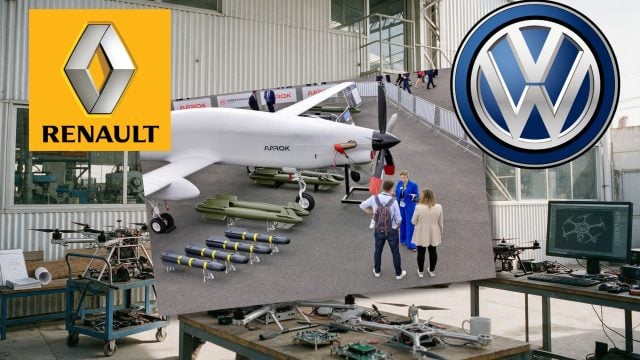
Renault, Volkswagen, Mercedes-Benz, and a constellation of suppliers like Schaeffler, Forvia, and Valeo are transforming their car manufacturing lines into production chains for drones, loitering munitions, and anti-drone systems. This phenomenon is no longer mere speculation; there are signed contracts, designated plants, and production schedules underway for war. Would you still consider buying a Renault or Volkswagen knowing that they manufacture drones for war? Will the public tolerate automotive brands pivoting to the war industry, or will they respond by boycotting these companies economically?
By El Ciudadano
Renault: The Pioneer Already Producing Drones at Scale
Renault stands out as the most advanced case in all of Europe. The French company confirmed in January 2026 that it would produce long-range military drones at its plants in Le Mans (chassis) and Cléon (engines), in collaboration with French defense contractor Turgis Gaillard. The contract spans ten years and has a potential value of 1 billion euros, targeting a production rate of 600 units per month.
However, the most ambitious leap came in June 2026, when Renault signed a second deal, this time with Thales, to manufacture the kamikaze drone Toutatis, aiming for 1,000 units per month starting in 2027, primarily for export.
Volkswagen: Emden’s Rescue Depends on the Bundeswehr
Volkswagen’s situation is different, and more desperate. The Emden plant in Lower Saxony was slated for closure. Reports from August 2026 indicate that the group is considering repurposing it to manufacture drones and heavy military trucks for the German army and NATO ally countries.
However, this plan hasn’t been without internal tensions. At the Emden workers’ assembly, CEO Oliver Blume was met with boos and protests from unions opposing the military conversion as a solution to overstaffing.
Mercedes-Benz: Integrating, Not Producing Drones
Mercedes-Benz has chosen a different path: it does not produce drones but rather integrates them into its vehicles. In June 2026, the company signed a memorandum of understanding with Munich startup Tytan Technologies to develop the system «Drone Defender». It will use modified Class G vehicles and Sprinter vans as mobile platforms for detecting and taking down enemy drones.
Unlike Renault, Mercedes-Benz isn’t repurposing car production lines but adds a layer of defense to existing vehicles. Consequently, the potential impact on consumer perception could be lower, yet not negligible: the Class G is a global consumer icon.
Suppliers: Schaeffler, Forvia, Valeo, and Deutz
Major component manufacturers have often been quicker than automakers themselves.
Schaeffler has signed agreements with German Helsing and French Delair to produce combat drones and interceptors. The new production line at a Delair plant in France aims for 100 drones per day starting November 2026. Models include Damoclès, already in service in the French military, and the interceptor Aspik.
Forvia has announced an alliance with a European company specializing in AI-powered anti-drone systems and is evaluating building a facility in France with a capacity of 1,000 interceptor drones per month.
Valeo will manufacture in France, starting early 2027, heavy rare-earth-free electric motors for drones from the defense startup Harmattan AI.
Deutz, through its subsidiary SOBEK, produces propulsion systems for drones and has partnered with ARX Robotics to assemble the ground drone Gereon at its Ulm plant, expecting deliveries to Ukraine from summer 2026.
Stellantis: The Exception That Confirms the Rule
Against this tide, Stellantis maintains a cautious stance. Its president, John Elkann, has repeatedly expressed skepticism about the integration of the automotive and defense sectors in Europe. While there has been speculation about potential involvement, the company has not announced concrete plans to repurpose its plants for arms manufacturing or drones.
Workers’ Reactions: «We Didn’t Sign Up to Manufacture Weapons»
The conversion process has not been peaceful. At Renault, the CGT has organized protests outside the Le Mans and Cléon plants. «We didn’t sign up to manufacture armaments,» declared the union, arguing that «taking advantage of the march towards war will never benefit workers.»
A union representative from Force Ouvrière expressed bluntly: «We agreed to produce cars, not weapons.» The internal division is real: some employees see military production as job security; others consider it a betrayal of the company’s identity.
At Volkswagen, the 4,000 employees at Emden briefly blocked the CEO’s car in a sign of protest.
Commercial Risks: Will Customers Boycott War Brands?
Here’s the question that no automaker wants to answer publicly: What happens when a buyer of a Clio, Golf, or Class A discovers that the same company manufactures kamikaze drones?
The signs are not encouraging. The German automotive industry generated €536 billion in revenue in 2024, while the five largest defense companies in the country managed to generate barely €30 billion. Defense remains a much smaller business than automotive. Yet the calculation is not just financial; it’s reputational.
The risk of a boycott is real, albeit difficult to quantify. In France, where Renault has a loyal customer base and a strong national identity, the association with the arms industry might erode sympathy from younger urban buyers who are particularly sensitive to ethical issues. In Germany, where pacifism has deep roots in post-war political culture, Volkswagen could face a similar dilemma.
Moreover, there exists the cybersecurity risk: a company that produces military drones becomes a target for cyber attacks, which could also affect its civilian vehicle production systems and consumer trust in product safety.
Are you willing to finance war and the construction of machines that often lead to civilian casualties when purchasing your car?
Workers Oppose Military Conversion to Fuel the War
The opposition of workers to the military conversion of European factories is a growing and increasingly organized phenomenon. At Volkswagen’s Emden plant, tensions peaked during the assembly on August 26, 2026, when CEO Oliver Blume was met with boos and jeers from over 4,000 employees gathered in the hall. Before entering, his car was briefly blocked by workers at the factory gate, with the overall atmosphere described as «very tense».
Reactions at the Emden Assembly
The meeting, far from calming emotions, exposed deep distrust towards management. Blume attempted to appeal for unity with a generic message —»we are fighting for industrial prospects»— but offered no new information or concrete plans for the center’s future. In fact, he repeated that there is no competitive workload for Emden, Hannover, Zwickau, and Neckarsulm looking towards the decade of 2030, which was perceived not as a solution, but as a confirmation of uncertainty.
The workers’ representatives responded forcefully:
- Manfred Wulff, president of the Emden works council, directly criticized management for management errors and demanded transparency for the approximately 8,000 employees at the plant. His central argument was that «the key to efficiency is the full utilization of the factory,» rejecting the notion that militarization is the only solution. Wulff had previously criticized the council’s «poor communication» and summarized the general sentiment with a phrase: «The workforce is insecure«.
- The mayor of Emden, Tim Kruithoff, presented Blume with a city council resolution defending the maintenance of the plant. His message was clear: «The people here only want one thing: jobs, and they want to keep building cars«.
- Daniela Cavallo, president of the Volkswagen Group works council, stated after the assembly that «our trust in this board of directors, particularly in its president Oliver Blume, has been damaged. Not irreparably yet. But damaged».
Union Rejection of the “War Economy”
Opposition extends beyond the assembly. A group of 28 delegates and members of IG Metall works councils from various Volkswagen plants (Braunschweig, Kassel, Wolfsburg, Saxony) signed a declaration outright rejecting military conversion. In the document, they accuse those promising jobs through arms production of «exploitatively abusing the existential fears of the workforce» in the automotive sector.
Their arguments go beyond a pacifist stance:
- Does Not Guarantee Peace, Prepares for War: They argue that rearmament does not ensure peace but «prepares the ground for war«.
- Loss of Labor Rights: They warn that a declaration of «state of emergency» could lead to the abolition of strike rights, imposition of labor obligations, and forced extensions of working hours. Additionally, the «Employment Guarantee Law» could impose mandatory service under threat of imprisonment for qualified workers in case of war.
- Profit Only for Capital: They argue that the arms industry celebrates «explosive profits» while workers and their families suffer the outcomes. VW workers «must produce the weapons with which their children or themselves will be sent to war to kill workers from other countries and die for the interests of German imperialism».
Conflict Extends to Renault
Discontent is not exclusive to Volkswagen. At Renault, tension has been mounting since management announced in January 2026 its plan to produce military drones at the Le Mans and Cléon plants. On September 21, 2026, coinciding with International Peace Day, the CGT organized a rally in front of the Le Mans factory gates, drawing about 80 participants. Protesters chanted slogans such as «no to the war economy» and «it’s criminal«.
The protest garnered support from unions such as Solidaires, the League for Human Rights, the Peace Movement, and the French Communist Party. The CGT has also demanded the creation of a conscience clause allowing workers not to participate in the production of war weapons.
Critical voices within Renault are clear:
- Thomas Vincent, CGT representative at Renault Le Mans, stated: «Ethically, this raises many issues. Employees did not sign up with Renault to build drones. But we don’t want to set unions and employees against each other because we also hear that this creates activity«. He added that workers «want to diversify our activities, but not for military purposes» and that «this is not a solution for maintaining factory activity. We prefer to focus on our expertise in automotive«.
- Florent Grimaldi, CGT representative, asserted that workers «are not happy about the general move towards war» or that states invest billions in armaments while resources for firefighters, teachers, and hospitals are lacking.
- Didier, a voluntary worker who backed out: «I was slated for the drone […] At first, I was not against it. And then, when I saw what it was for…«. His testimony reflects the ethical dilemma many employees face.
Unions also highlight that, although some surveys indicate that over 90% of the 2,000 workers in Le Mans support the project, only twelve people have volunteered for the testing phase. This suggests that stated support does not necessarily translate into a willingness to participate directly.
Forvia and Valeo: Supplier Rejection
The announcements from French suppliers Forvia and Valeo —the former for manufacturing AI interceptors and the latter for producing electric motors for military drones— have also sparked union sector rejection, labeling them as «war profiteers«.
Forvia announced in July 2026 an alliance with a European defense company specializing in AI-driven anti-drone systems, planning to set up a production line in France capable of 1,000 interceptor drones per month. Valeo has officially confirmed it will manufacture dedicated electric motors for drones in France under a contract with military tech firm Harmattan AI.
While there have been no mass protests at these companies like at Renault or Volkswagen, union representatives have voiced their rejection of presenting military conversion as the only alternative to maintain employment in the component sector.
El Ciudadano
Obtén tu Pasaporte y apoya a El Ciudadano
Elimina la publicidad, accede a contenido exclusivo y sé parte de la comunidad.
Cancela en cualquier momento · Sin permanencia