Original article: “No pueden desacreditar nuestra espiritualidad”: comunidades mapuche-williche destacan fallo contra Radio Bío Bío como freno a la criminalización mediática
Mapuche-Williche Communities Celebrate Court Ruling Against Radio Bío Bío: A Victory Against Media Criminalization
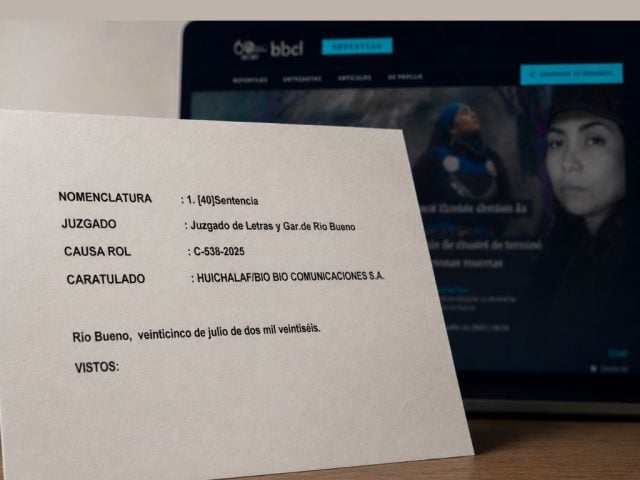
The recent ruling by the Court of Letters and Guarantee of Río Bueno, which deemed two articles by Radio Bío Bío discriminatory against Machi Millaray Huichalaf, has been hailed by Mapuche-Williche communities as a significant barrier against media stigmatization and criminalization.
The court upheld the complaint submitted by Aylla Rewe of Ngen Mapu Kintuantü—a political and territorial coalition representing Mapuche communities—and Machi Millaray Huichalaf against BioBio Comunicaciones. The ruling, which recognized arbitrary discrimination, arises from two articles published in September 2025 and represents a major setback to narratives that have historically marginalized ancestral authorities.
Members of the Mapuche-Williche community highlighted the ruling’s significance as a mechanism to «counter hate speech, stigmatization, and criminalization faced by indigenous authorities, women, and those defending our territories.«
They stated, «Freedom of the press should not be used to undermine our spirituality, our culture, and our forms of organization,» as conveyed in a formal statement.
This legal action, propelled by collective decision-making, responds to journalistic coverage from September 2025 that threatened the dignity of Machi and questioned her role as a human rights and environmental advocate.
The ruling mandates BioBio Comunicaciones to correct the discriminatory expressions, publicly announce the outcome, and train their journalistic staff, measures that the community sees as vital to changing how indigenous peoples are portrayed in the media.
Members of Aylla Rewe appreciated the support from lawyers Rodrigo Pizarro and Gonzalo Sánchez, who led the case, as well as the individuals and organizations that showed solidarity or provided various forms of assistance.
«Their contributions have helped pave a path where the decisions, political direction, and community leadership have always been in the hands of Machi Millaray Huichalaf and the Aylla Rewe of Ngen Mapu Kintuantü,» they emphasized in their statement.
Beyond this specific case, the Williche community hopes this resolution serves as a wake-up call for all media and third parties to, «report on indigenous peoples with respect, responsibility, and cultural relevance.«
While the ruling may be contested, the Aylla Rewe will remain vigilant to ensure compliance, reaffirming their commitment to defend their spirituality, ancestral authority, and the right to protect the Pilmaiquén River and other sacred sites.
Key Aspects of the First Ruling Applying the Zamudio Law to a Media Outlet
For the first time since the implementation of the Zamudio Law in Chile, a court has condemned a media outlet for discrimination in its journalistic coverage. The Río Bueno Court ruled in favor of Machi Millaray Huichalaf against Radio Bío Bío, specifically regarding two reports aired by BBCL Investiga in September 2025. The ruling does not challenge the right to investigate matters of public interest but focuses on how narratives were constructed: the use of a stigmatizing nickname, quotation marks that questioned her spiritual authority, and a caption that suggested a negative evaluation.
The court ordered the removal of the nickname «the machi of sacrifices» and its replacement with «machi Millaray Huichalaf,» removed the quotation marks around the word machi, and changed the caption from «A Lost Woman» to a factual description. Additionally, the outlet must publicly explain the corrections, train 90% of its journalistic staff on discrimination and freedom of expression, and pay a fine of 10 Monthly Tax Units.
The ruling distinguishes between intent and discriminatory effect, determining that while there was no deliberate intent to discriminate, the language and editorial choices objectively resulted in that outcome. This resolution, which can still be appealed, establishes an important precedent by applying the Zamudio Law to journalistic coverage, underscoring that freedom of the press must be exercised with consideration of the effects of language on fundamental rights, especially concerning women, indigenous authorities, and territory defenders.
From the Observatorio Ciudadano, it was indicated that this ruling sets a precedent for the journalistic treatment of indigenous authorities, women, and land defenders, reaffirming that freedom of expression and press must be exercised with respect for fundamental rights, making it clear that: «When the press discriminates, there are consequences.»
Obtén tu Pasaporte y apoya a El Ciudadano
Elimina la publicidad, accede a contenido exclusivo y sé parte de la comunidad.
Cancela en cualquier momento · Sin permanencia