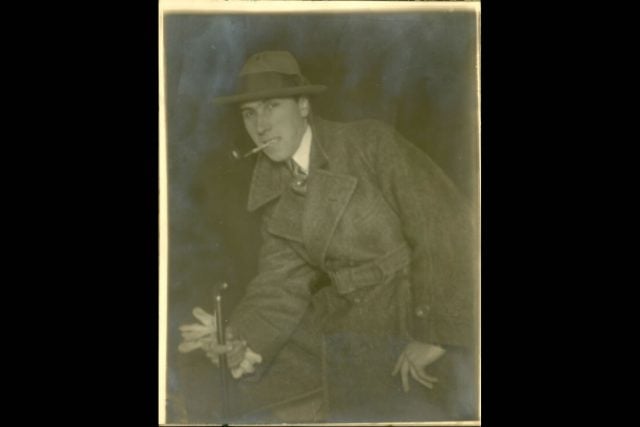
Original article: Juan Marín: Un escritor chileno en tierra de nadie
By Felipe Reyes F., Writer and Editor
Chilean literature sometimes easily conceals identities until they fade into obscurity.
This isn’t about those trendy authors whom time justly sweeps away, but rather writers who, for some difficult-to-pinpoint reason, remain trapped in a blind spot of tradition. They don’t disappear entirely; they persist in circumstantial chronicles, footnotes, editorial catalogs, specialized dictionaries, and in the memories of a few reader-excavators.
Juan Marín belongs to that category. His name often appears accompanied by a list that seems too novel-like to be true: doctor, sailor, diplomat, traveler, aviator, boxer, poet, novelist, and essayist.
Such a biography is so filled with movement that it risks becoming a caricature. Yet, the true enigma lies not in all that he accomplished, but in a more troubling question: why did a writer who was awarded and admired by his contemporaries end up occupying such a marginal place in Chilean literary history?
Perhaps the answer is that Marín wrote for a country that did not yet exist.
While Chilean literature in the 1920s and 1930s sought to construct a national identity—Mariano Latorre’s countryside, Manuel Rojas’ tenements, Joaquín Edwards Bello’s city life, Marta Brunet’s provincial life—Marín wrote from the movement. His homeland was displacement. His settings were not the central valley but the southern seas, Indian ports, the streets of Shanghai, Tibetan monasteries, and the ruins of Egypt.
In a tradition obsessed with defining what Chile was, he seemed to ask a different question: what happens when a Chilean leaves the territory and discovers that the world is infinitely more complex than any narrative.
The Sum of the Parts
Born in Talca on March 23, 1900, Juan Marín Rojas completed his secondary education at local high schools in his hometown and in Constitución. He then studied Medicine at the University of Chile, where he also promoted the History of Medicine course.
He worked as a naval doctor and later embarked on a diplomatic career that would take him across Africa and Asia. He was interested in Gómez de la Serna, the pre-jazz rhythm, futurist art, and airplanes. He even wrote a book of poems imagining the future world with the advent of these flying machines, titled Looping, published in 1929.
In a chronicle by Alfonso Calderón, Marín declared that he drafted his poems “between one patient and another, between one operation and the next, soaked in ether and disinfectant, on sheets of paper with hospital and clinic letterheads. The conversations of my colleagues and the noise of the ambulances didn’t bother me, nor the dramatic atmosphere that fills public assistance locales.”
Afterwards, he always found time to actively contribute to the press, in publications such as the magazines Atenea, Zig-Zag, En Viaje, and Costa Rica’s Repertorio Americano, as well as newspapers like El Austral in Temuco, La Unión in Valparaíso, and El Mercurio in Santiago.
However, it would be a mistake to read this biography as a simple accumulation of initiatives and adventures. Marín does not belong to the genealogy of the romantic adventurer. He resembles those writers for whom experience constitutes a form of research. Traveling wasn’t a pastime; it was a method of understanding. Medicine taught him to observe; diplomacy taught him to listen; literature helped him express both in language.
There is a decisive difference between a tourist and a writer who draws from their travels.
The former confirms their expectations; the latter destroys them. Juan Marín belongs to the latter group. His books never use exoticism as a spectacle. The East does not appear as a picturesque backdrop meant to enchant the Western reader, but as a civilization that demands the abandonment of one’s biases. Decades before Edward Said published Orientalism, Marín sensed that true travel begins when the traveler stops feeling like the center of the world.
Perhaps that’s why his works feel more modern today than many Chilean novels of his time.
In Paralelo 53 Sur, published in 1936 by Nascimento (which won the Municipal Prize of Santiago), he recounts the social conflicts between those who amass wealth and those who produce it, in a play of tensions that Marín galvanizes into an epic about the exploitation of gold, wool, and petroleum in the Tragic Patagonia.
The southern landscape of Marín ceases to be a mere setting and becomes a moral force. Nature does not beautify action: it tests it.
Following in Conrad’s wake, in his chronicles and novels, the sea does not symbolize freedom but uncertainty. Francisco Coloane came to occupy the symbolic place of the great narrator of southern Chile, and rightly so, but before Coloane solidified that literary geography, Juan Marín had already discovered that the southernmost part wasn’t just a geographical border; it was a laboratory where humans faced their own limits. They didn’t compete with each other; they explored neighboring regions of a single imagination.
A similar effect occurs with Salvador Reyes. Both understood that the ocean was more than just a landscape: it was a way of thinking. In a literature historically tied to the mountains and agricultural valley, they both helped restore the sea to Chile—not as a patriotic metaphor but as an experience.
Their characters inhabit territories where certainties have yet to be fully constructed. Their writing seeks not merely to depict remote places but also to probe how those places transformed those who inhabited them.
Luis Merino Reyes, one of his early scholars, emphasized another key point: the impossibility of separating the writer from the doctor and the diplomat. Clinical observation, contact with other cultures, and narrative imagination formed a single lens. Perhaps that’s why Marín’s prose possesses a rare quality: even when describing extraordinary scenes, it retains an almost scientific precision. He never exaggerates because he knows that reality is often more improbable than fiction.
However, literary canons also obey and receive the lash of trends. By the 1960s, the emergence of the so-called Latin American Boom shifted interest towards other narrative forms: formal experimentation, grand political allegories, magical realism, urban novels.
Juan Marín ended up situated in a limbo. Too classic for newer generations; too cosmopolitan for those still searching for a literature that highlighted the slippery national identity. Thus, in the displacement where his work was archived, his life extinguished on February 10, 1963, in Viña del Mar, at the age of sixty-three.
There’s an inevitable irony in this fate. Today, as we talk about globalization, the circulation of cultures, migration movements, or transnational literature, Marín seems like a perfectly contemporary writer. Many questions that traverse his work—how to view the other, how to write from the experience of travel, how to think identity outside national borders—are precisely the questions dominating much of today’s essays and narratives.
Literature and Psychoanalysis
There’s a less visible dimension of his work that helps explain the innovation of his writing in early 20th century Chile: his early interest in psychoanalysis.
Long before Sigmund Freud became a name associated with the medical or philosophical realm and began circulating among Latin American writers and artists, Juan Marín had already integrated the Freudian universe into his fiction.
The body was no longer enough to explain human behavior; there was a dark region—repressed desires, guilt, mourning, memory—that demanded a different approach and language, with literature serving as an ideal laboratory for exploration.
In stories like “Margarita, the Aviator and the Doctor” or “The Secret of Doctor Baloux,” everyday suffering gains a psychological depth rarely found in the national narrative of those years.
This wasn’t an isolated curiosity, as Freud’s fascination extended beyond the medical sphere. While Europe witnessed the rise of Nazism and the creator of psychoanalysis was persecuted for being Jewish, a group of Chilean writers and professionals decided to make that persecution their own cause.
In April 1938, a homage to Freud was held in the Honor Hall of the University of Chile, organized by the Alliance of Intellectuals of Chile for the Defense of Culture, chaired by Neruda. Among the attendees was Juan Marín, then president of the Medical Society of Valparaíso, who read a text supporting psychoanalysis and defending Freud as a symbol of the persecuted intellectual.
A month later, in May 1938, the Medical Society of Valparaíso would push for another tribute. But this time, the gesture took on a much more concrete character. It aimed to manage the rescue or asylum of Freud so that he could spend his final days in Chile, away from the persecution escalating after the annexation of Austria by Nazi Germany.
This initiative never materialized, as Freud’s health deteriorated rapidly. The cancer affecting his jaw made any long-distance travel increasingly difficult. He ultimately left Vienna for London, where he would die a year later.
Sometimes, literary friendships rarely survive intact against politics, fickle egos, or diplomacy. In his memoirs, Confieso que he vivido, Neruda recalls a trip to India he made in 1950, referring to the harassment he suffered at the hands of the police in that country, blaming Juan Marín, then Chile’s ambassador, for not intervening to stop the mistreatment he experienced.
For the poet, Marín was already “calmed, possibly due to age and diplomatic privileges. He showed no indignation at the stupid attitude of the Indian government—Neruda asserted. I did not ask for any solidarity, and we parted amicably, he surely relieved of the heavy burden my visit brought, and I disappointed forever in his sensitivity and friendship.”
This episode occupies not much more than a couple of pages in Neruda’s memoirs, but it’s enough to highlight the rupture of a relationship that had been marked by intellectual closeness and shared causes, such as the defense of Freud.
In his poem “Cuándo de Chile” (from Las uvas y el viento), Neruda wrote that the country is a “long petal of sea, wine, and snow.” The phrase turned into a sentimental definition of territory. Juan Marín, on the other hand, seemed to understand something else: that this petal did not end at the coast. It continued inland, to the ports of Asia, the temples of India, the sands of Egypt, anywhere a Chilean might discover that identity is not an unmoving root but a conversation with the world.
The doctor understood the value of facts; the novelist knew that facts alone cannot explain a life. This tension between experience and fiction permeates all his work. He traveled to observe. He wrote to comprehend what he had seen.
Perhaps that’s why his taxonomy of “travel writer” fades away. It is also not enough to say he was a doctor who wrote novels or a diplomat-writer. Juan Marín did something uncommon in the Chilean tradition: he turned the whole world into narrative material without ceasing to write from Chile. He did not take Chilean literature abroad; he brought the world into Chilean literature.
There are authors whose posterity lies in their continued readership. Others, however, await each generation to rediscover them. Juan Marín remains in that latter category. There lies his work, silent, like those southern ports where his characters once disembarked: waiting for someone to set sail again.
By Felipe Reyes F., Writer and Editor
Obtén tu Pasaporte y apoya a El Ciudadano
Elimina la publicidad, accede a contenido exclusivo y sé parte de la comunidad.
Cancela en cualquier momento · Sin permanencia