Original article: «Una tiene que creerse el cuento como poeta y como persona que es»: María Monvel, la escritora que se antologó a sí misma y usó el chisme para triunfar en España
By Osvaldo Carvajal M., Director of Community Engagement, Faculty of Education and Humanities, U. Andrés Bello
We have often discussed the caricatures that the literary canon has painted of female writers. Mistral, the great mother; Brunet, the aunt of children’s tales; Thèrése Wilms, the cursed poet… But today’s case is among the worst.
Despite the recognition she received during her lifetime, if you ask someone today about María Monvel, they will likely say, «Oh, yes, that’s a street in La Reina.» Of course, she was much more than that. So, let’s delve into the archives!
To grasp who we are discussing, here is what Lucila Godoy said about Monvel: «The best poetess of Chile, but more than that: one of the great poetesses of our America, close to Alfonsina Storni for the richness of her temperament, and to Juana de Ibarbourou for her spontaneity.»
Our Nobel Prize winner places her comadre (literally, she was the godmother of her daughter) at the pinnacle of Latin American poetry. And Monvel knew how to leverage such an impressive introduction.
Ercilia Brito Letelier —yes, we appreciate the choice of the pseudonym María Monvel— did not come from the Santiago elite but from a once-bourgeois family in Iquique. Hence, although she received a secular education in high schools and had private artistic training, she had to learn to navigate the intellectual field strategically.
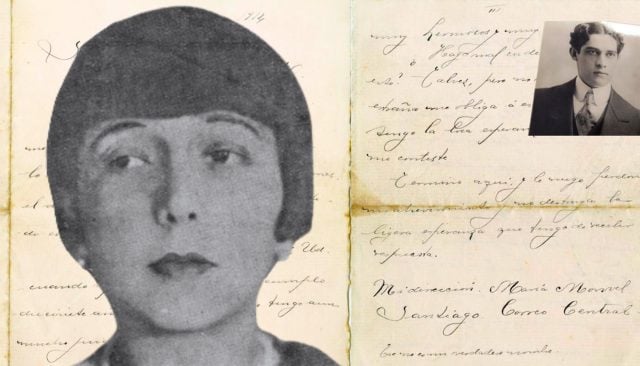
In 1914, still a high school girl at just 16 years old, she made her first move: she began writing flirty letters to the poet Julio Munizaga. Fernanda Moraga and Naín Nómez highlight how, in these letters, she portrays herself as a girl who «lacks judgment» and apologizes for her boldness while praising his «passionate and fiery poetry» and his «beautiful blue eyes.»
The first letter begins with «You do not know my name» and ends signed with the pseudonym she would use for the rest of her career. Thus, María Monvel was born.
In those letters, Monvel not only flirted: she commented on her readings and began to develop her own critical voice, which would soon break out of their private exchanges. In 1915, she published her first poem in Figulinas, and by 1917, her works started appearing in Zig-Zag, the same year Selva lírica included her (though with her name misspelled) among the young promises of Chilean poetry.
This was her first appearance in an anthology, a genre that would be crucial for her recognition.
Before we continue: do we understand what an anthology is? Simply put, it’s a collection of texts that someone gathers because they believe they are worth highlighting. Thus, there is something of a consecration in it: to be anthologized is to be chosen. And when dedicated to a single author, it usually gathers already published texts. It’s somewhat like a Greatest Hits album.
Now imagine a Greatest Hits album made up almost entirely of unreleased songs. Strange, right? Something like that happened with Monvel in Spain. Although she was already circulating in Latin America, her name did not exist there.
It’s hard to believe that Editorial Cervantes independently gathered 35 poems missing from her previous books and introduced them with the aforementioned Mistral tribute. This suggests that Monvel herself crafted this poetry collection disguised as an anthology published in Spain, with which she would return to Chile. And that wouldn’t be the most daring thing she would do in Europe…
These were times when Pío Baroja’s phrase still resounded: “America is the stupid continent.” Monvel learned this firsthand when she managed to visit the monumental José Ortega y Gasset, who received her with indifference and disdain. But she had a plan: «I wouldn’t leave Spain without becoming friends with Ortega y Gasset.»
The opportunity came when Rosa Spottorno, the philosopher’s wife, came to visit her: «I spoke badly of her husband as much as I could. And she —I relied on that— repeated it to him.» It worked. Ortega «felt flattered by that creole resentment that had awakened in a little Indian woman from South America» and invited her to tea. Then came other meetings, and Monvel achieved what she had set out to do. Gossip triumphed.
The friendship, however, did not last. In 1928, Monvel wrote to Guillermo de Torre: «Send me news of my ex-friend Ortega, because since I left Madrid, he has completely forgotten me.» By then, it mattered little: she had returned to Chile anthologized by a Spanish publisher. And she wouldn’t abandon this method.
In 1929, she published Poetisas de América, an anthology of American writers in which she, of course, included herself. To do so subtly, she resorted to the old reliable: yes, she used Mistral’s praise with which we opened this chronicle.
Ercilia understood early on that to succeed as a writer, one must make a name, build networks, and manage one’s own prestige. One must believe in the story. And she believed it so much that she titled her last book —yes, another anthology— Her Best Poems.
The incredible part is that, after all her effort, we ended up believing her name was merely a street in La Reina. The payment of Chile…
Osvaldo Carvajal M.
Obtén tu Pasaporte y apoya a El Ciudadano
Elimina la publicidad, accede a contenido exclusivo y sé parte de la comunidad.
Cancela en cualquier momento · Sin permanencia