Original article: Día Mundial de la Alimentación: América Latina exporta alimentos al mundo, pero tiene la dieta saludable más cara del planeta
Every October 16 marks World Food Day, commemorating the founding of the FAO in 1945.
This year, the FAO calls for action under the theme “Innovate Today for Nourishing Tomorrow.” According to the Latin American organization Animal Interseccional, the most pressing innovation in addressing hunger does not stem from laboratories but requires a reassessment of what is produced, how it is done, and for whom.
According to the report The State of Food Security and Nutrition in the World (SOFI 2026) compiled by FAO, IFAD, UNICEF, WFP, and WHO, 645 million people experienced hunger in 2025, equating to 7.8% of the global population.
Additionally, 2.69 billion people could not afford a healthy diet: that’s 32.7%, nearly one-third of humanity.
In Latin America and the Caribbean, hunger has decreased to 4.8%, yet an estimated 32 million people are still affected. At the same time, the region has the most expensive healthy diet in the world, costing $4.91 PPP (purchasing power parity) per person per day, with one in four individuals (25.7%) unable to afford it.
All this occurs in a region that is an agricultural powerhouse.
Part of the explanation lies in the distribution of cultivated products. A 2013 study from the Institute of the Environment at the University of Minnesota, published in Environmental Research Letters, estimated that 36% of the calories produced by global crops are directed towards feeding livestock, while only 12% of these calories reach human consumption as meat, milk, eggs, and other animal products.
The issue is not a lack of food but rather the structure of the system that produces it. A model that channels grains through animals to produce meat, milk, and eggs wastes food, concentrates resources, and excludes those who are most in need.
“In Latin America, we produce food for the world, yet eating healthily here is more expensive than in any other region. This is not scarcity; it’s a decision about the production model. The talk of innovation implies that the solution to hunger must come from laboratories, but real transformation is possible today: we must stop allocating land and grains for livestock and instead prioritize feeding people,” said Jesica Bon Denis, executive director of Animal Interseccional.
“There can be no food justice in a system that turns millions of animals into commodities while millions of people go hungry,” she added.
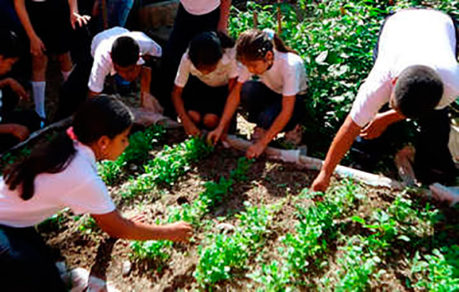
The organization promotes concrete solutions. Through its Green Agenda program, it offers free advice to professionals and public institutions aimed at incorporating plant-based protein options in school, hospital, and university cafeterias.
With its «Community that Nourishes» initiative, it extends this work to underserved communities, ensuring that a plant-based, nutritious, and affordable diet is not a privilege for a select few. “Nourishing tomorrow begins with deciding today what goes on our plates,” Bon Denis concluded.


Obtén tu Pasaporte y apoya a El Ciudadano
Elimina la publicidad, accede a contenido exclusivo y sé parte de la comunidad.
Cancela en cualquier momento · Sin permanencia