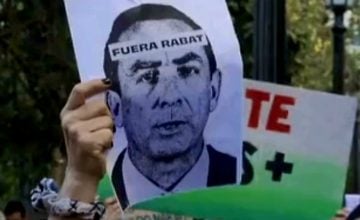
Original article: La «mano dura» de Kast: Rabat y Silva firmaron rebajas de penas a narco italiano, homicida neonazi y autor de femicidio frustrado
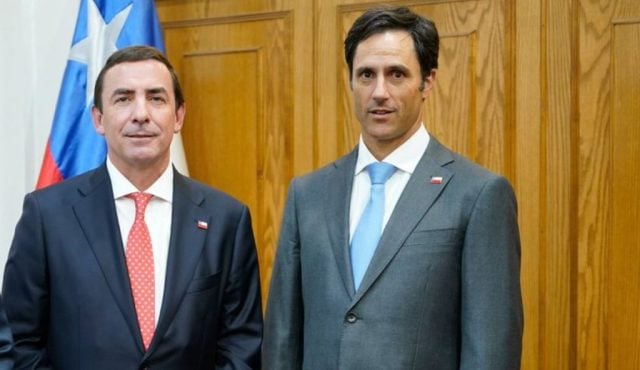
While José Antonio Kast has pledged during his electoral campaign to implement a «hardline approach against organized crime», the Minister of Justice and Human Rights, Fernando Rabat, and the undersecretary of the ministry, Luis Silva, signed a series of sentence reductions for convicted individuals, including an Italian drug dealer, a neo-Nazi murderer, and the perpetrator of a failed femicide.
This was disclosed by Bío Bío Chile, which accessed over a thousand decrees signed by high-ranking officials from the Justice Ministry that, while legally issued, contrast sharply with the security agenda promoted by the far-right president and his commitment to fulfilling the State’s duty to protect public safety.
Sentence Reduction for Italian Drug Dealer
The drug trafficker Massimiliano Beltrami, linked to the Italian mafia, was arrested in 2018 during the operation known as Operation Tirreno after being involved in a criminal network that imported four jet skis from Europe to South America, loaded with more than 103 kilograms of cocaine hydrochloride, valued at 4.5 billion pesos. An customs inspector became suspicious of the group upon noticing they were not tanned, despite claiming to be participating in a water sports tournament. Upon inspecting the jet skis, authorities discovered high-purity drugs, leading to Beltrami’s arrest while he guarded the cargo, resulting in a nine-year prison sentence.
On May 15, 2026, Minister Fernando Rabat reduced the Italian citizen’s sentence by nine months and 16 days, setting his release date for May 16 of the same year.
According to the decree, the Justice Ministry was «not authorized to deny the benefit of sentence reduction based on the seriousness of the crime and the protected legal interest» and cited the «uniform jurisprudence» of the Supreme Court, which mandated the issuance of the corresponding decree.
Although the original framework included his extradition to Italy after serving his sentence in Chile, Bío Bío Chile noted that it could not confirm his current legal status officially.
Neo-Nazi from “Battalion 38” Released 21 Months Early
Another notable case is that of Patricio Salas Villar, known as «Pato Cleto» and a member of the neo-Nazi group «Battalion 38», who was sentenced in 2017 to 13 years in prison for the murder of Isaac Araya Herrera, committed in October 2014 through an ambush using sharp weapons, sticks, and bats.
The prosecutor established that the neo-Nazis blocked the public roadway while issuing threats before inflicting abdominal wounds on the victim that caused hypovolemic shock. Despite the severity of the incident, Undersecretary Luis Silva signed a decree that forgave him 21 months and 97 days in prison, setting the end of his sentence for September 24 of the previous year, allowing him to regain his freedom.
Rabat Signs Decree to Benefit Attempted Femicide Perpetrator
The history of benefits granted by the Justice Ministry under Kast’s administration includes the case of José Teodulio Zúñiga Argel, nicknamed «el Joselo», accused of a hatchet attack in Chaicas, Region of Los Lagos.
In May 2019, after being rejected when attempting to assault the victim, the attacker returned in the early morning with a minor to brutally assault her. The woman suffered the amputation of two fingers, head injuries, and skull mutilation, remaining unconscious until assisted by her 11-year-old son.
“When I opened the door, I saw him with my nephew and then I don’t remember anything. Until I woke up about an hour and a half, two hours later, completely covered in blood. I was missing fingers. He took a chunk of my skull with the axe. I didn’t know what had happened to me because I didn’t even know with what he had attacked me (…) My life has changed 100%. He ruined my life, made me a mess,” recounted the victim as reported by Bio Bío Chile.
Despite having criminal records for domestic violence, the sentence for attempted femicide was reduced by one month and six days through a decree signed by Minister Rabat, again arguing that his portfolio could not prevent the benefit.
In cross-referencing journalistic files with the official decrees, the aforementioned media found sentence reductions granted to perpetrators of violent crimes across the country. Among those beneficiaries is Cristian Delgado Oyarzo, who murdered a truck driver in Osorno by stabbing in 2018, whose sentence was reduced by six months by Luis Silva. Additionally, Alan Araya Lemus, sentenced in Calama to 11 years for a crime at a service station, received an eight-month penalty reduction from Rabat. The list also includes Claudio Faúndez Chacón, who killed an acquaintance in Río Bueno and received a 13-month discount off his ten-year sentence.
Rabat Blames Congress for Regulatory Gap
In response to criticisms he received from lawmakers during a session of the Chamber of Deputies over the sentence reductions granted to serious criminals and sexual offenders against minors, Minister Fernando Rabat stated that he had to comply with decisions made by the Supreme Court and attributed the responsibility to the National Congress for omissions in the 2022 reforms that should have excluded convicts of sexual crimes against minors from receiving benefits, indicating that the lack of transitional regulations left gaps in the application of retroactive benefits.
The Secretary of State suggested that evaluating the petitions belongs solely to the evaluation committees according to Law No. 19,856, arguing that objecting to such rulings would violate Articles 6 and 7 of the Constitution regarding the limits of ministerial powers.
To justify the government’s position, Minister Rabat detailed that an initial attempt was made to deny the prisoners’ applications. However, the criteria had to be radically changed after the country’s highest court accepted multiple writs of protection ordering the Executive to refrain from reviewing reserved criminal matters.
«I hope I receive an explanation on how I can stop complying with a ruling from the esteemed Supreme Court without violating the oath I took in this Full Congress on March 11, 2026,” Rabat stated in the legislative hall, justifying the controversial decrees signed alongside his ministerial team.
Obtén tu Pasaporte y apoya a El Ciudadano
Elimina la publicidad, accede a contenido exclusivo y sé parte de la comunidad.
Cancela en cualquier momento · Sin permanencia